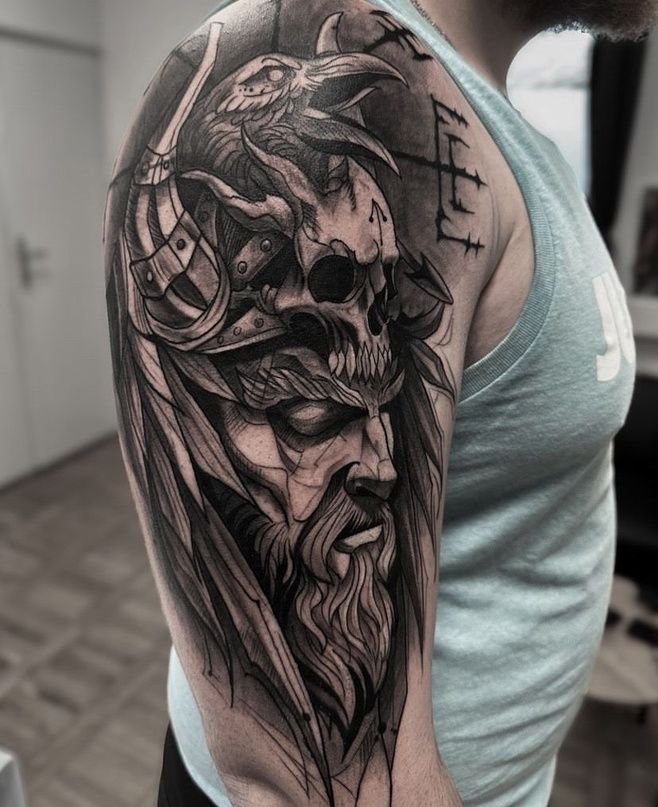
There’s something undeniably magnetic about a goth tattoo sleeve. Unlike a single standalone piece, a full or half sleeve transforms the arm into a living canvas — a continuous, immersive narrative told in ink, shadow, and symbolism. Whether it’s the haunting curve of a raven’s wing, the melancholy beauty of a wilting rose, or the intricate geometry of an occult sigil, gothic sleeves carry a depth that few other tattoo styles can match.
Goth-inspired tattoo art has remained a cornerstone of tattoo culture for decades, and for good reason. The aesthetic draws from an extraordinarily rich well of influences — Victorian mourning traditions, dark romanticism, classical mythology, horror literature, and the theatrical visual language of gothic subculture. This breadth means no two goth sleeves ever look quite alike, and there’s an idea for every personality and artistic vision.
If you’ve been dreaming of dark, dramatic, and deeply personal ink, this guide is for you. Below are 15 compelling goth tattoo sleeve concepts, complete with symbolism, placement tips, and creative directions to help you collaborate with your artist and make something truly extraordinary.
1. Ravens and Skull Memento Mori Sleeve
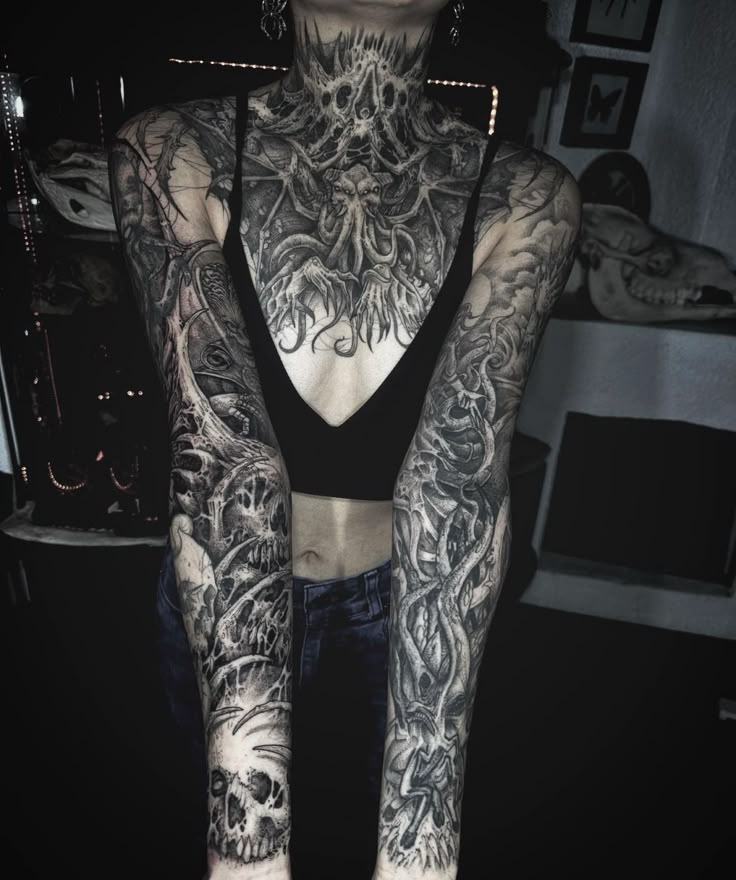
Few combinations hit harder in the gothic aesthetic than ravens paired with skulls. The raven has long been a symbol of transformation, magic, and the passage between the living world and the realm of the dead — immortalized most famously in Edgar Allan Poe’s haunting verse. When paired with a skull, the imagery taps directly into the Latin concept of memento mori, a reminder of mortality that the Victorians wore openly as a philosophy.
A sleeve built around this theme might feature a large, detailed raven perched on a cracked skull as a focal piece on the upper arm, with feathers cascading downward in a flowing, organic arrangement. Secondary elements like shattered pocket watches, dying roses, and wisps of smoke can fill the negative space, creating a seamless composition that wraps naturally around the arm.
In terms of style, black and grey realism lends this concept an almost photographic weight, while a blackwork or neo-traditional approach makes the symbolism bolder and more graphic. Consider adding fine-line script — a line from a poem or a personal inscription — winding through the composition for a literary, deeply personal touch.
2. Victorian Mourning Portrait Sleeve
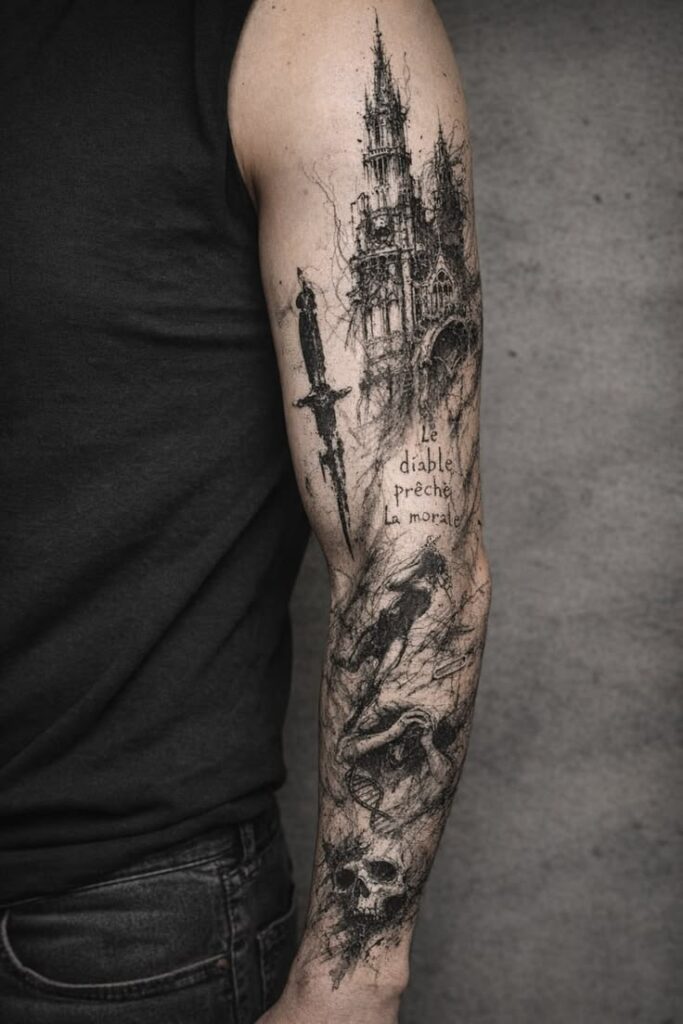
Victorian mourning culture produced some of the most hauntingly beautiful visual art in history. Mourning portraits, funeral wreaths, weeping willows, and jet-black mourning jewelry all carry an elegance that translates brilliantly to tattoo sleeves. This concept leans into that 19th-century obsession with grief as a formal, even beautiful, ritual.
A sleeve in this tradition might center on a Victorian portrait — a pale woman in black lace, eyes downcast, surrounded by mourning symbols like urns, cypress trees, and weeping angels. The composition benefits enormously from fine-line detailing, ornate framing devices like oval portrait borders or oval lockets, and a deep black-and-grey palette that evokes old daguerreotypes.
For those drawn to history and literary darkness, this sleeve concept feels both deeply personal and artistically ambitious. It pairs beautifully with other goth arm tattoo ideas that emphasize Victorian iconography, and can extend naturally into the shoulder and upper back for a larger installation.
3. Gothic Cathedral Architecture Sleeve
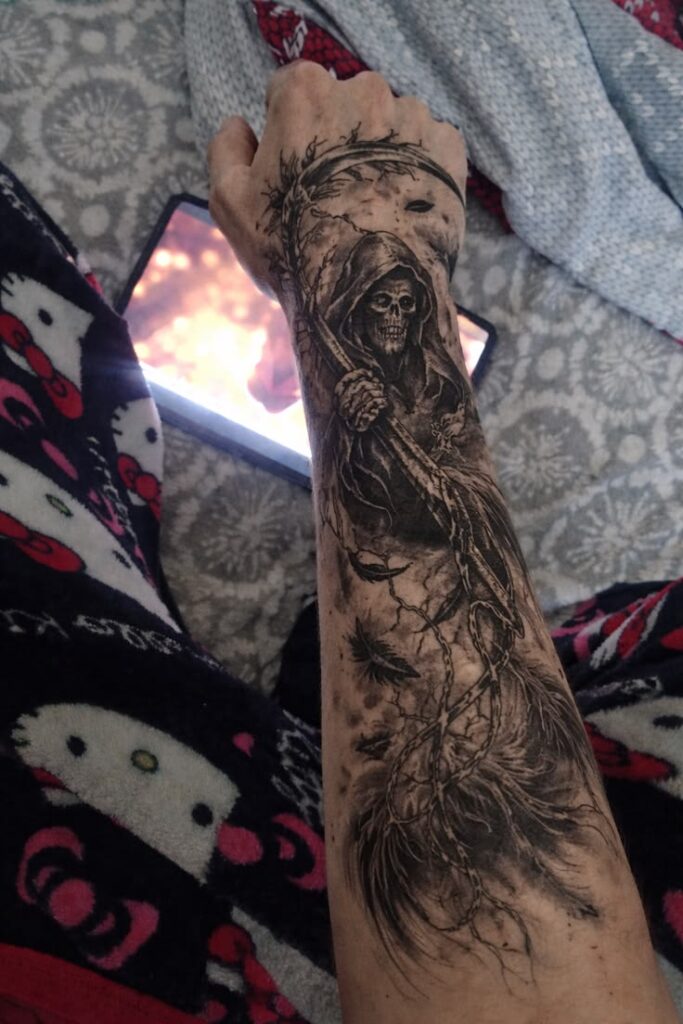
Gothic architecture — with its soaring pointed arches, ribbed vaulting, flying buttresses, and gargoyle sentinels — is one of the most visually commanding sources of inspiration for a tattoo sleeve. The geometry and grandeur of cathedrals like Notre-Dame de Paris or Cologne Cathedral translate remarkably well into the cylindrical shape of the arm.
An architectural sleeve might wrap the arm in a continuous panoramic view: columns and arched windows climbing from the wrist, gargoyles crouching at the elbow, and a dramatic spire or rose window opening up on the upper arm. The level of fine-line detail possible in this style is staggering — stone textures, intricate tracery patterns, and deep shadowing can make the arm look as though it’s carved from ancient stone.
The key to success with this concept is working with an artist who excels in architectural linework and geometric precision. Blackwork or dotwork styles are particularly well-suited here, and the design can be enhanced by adding raven silhouettes circling the spires or storm clouds rolling behind the stonework.
4. Dark Moon and Celestial Witchcraft Sleeve
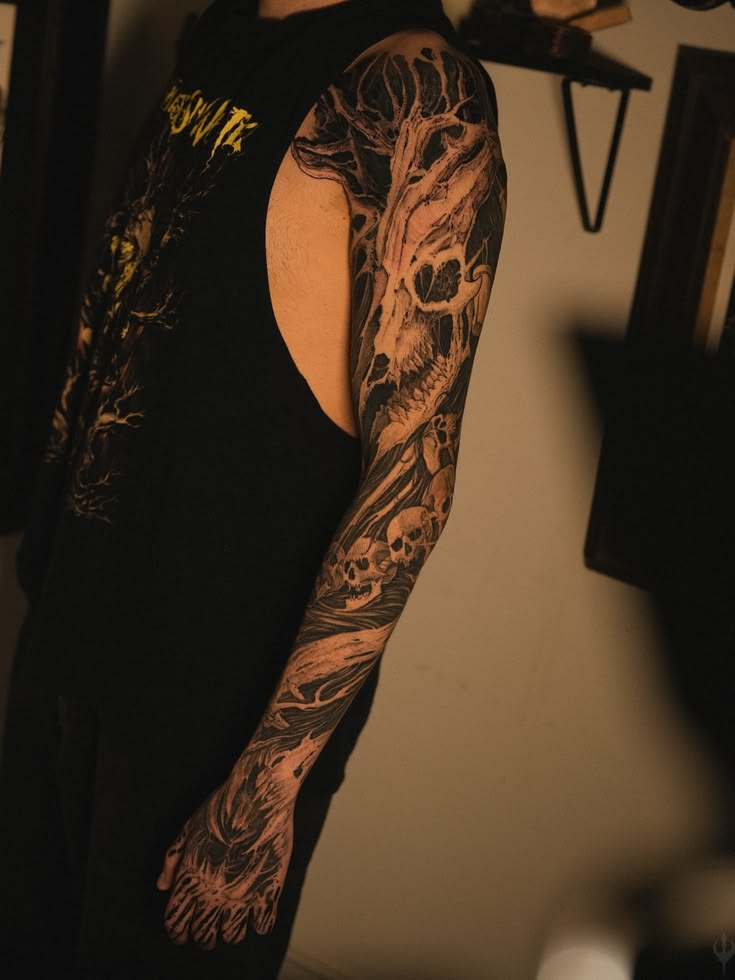
Moon imagery sits at the very heart of gothic and occult aesthetics. The lunar cycle — new moon to crescent to full — has represented feminine power, cycles of death and rebirth, and the mystery of night since ancient times. A celestial witchcraft sleeve weaves these themes together into something that feels both mystical and intensely personal.
This sleeve concept might feature a large, detailed full moon as the centerpiece, surrounded by moth wings, trailing smoke, phases of the moon arranged in a vertical or spiral sequence, and fine-line constellation maps. Black cats, crystal balls, mortar-and-pestle arrangements, and botanical herbs like belladonna or wolfsbane add richly textured detail throughout the composition.
Placement is highly flexible — the full moon works beautifully on the upper arm or forearm, and a crescent moon positioned on the inner wrist feels especially intimate. The aesthetic sits at a gorgeous intersection between dark femininity and raw occult power, and it adapts effortlessly to both minimalist fine-line and bold illustrative approaches.
5. Vampire and Dark Romance Sleeve
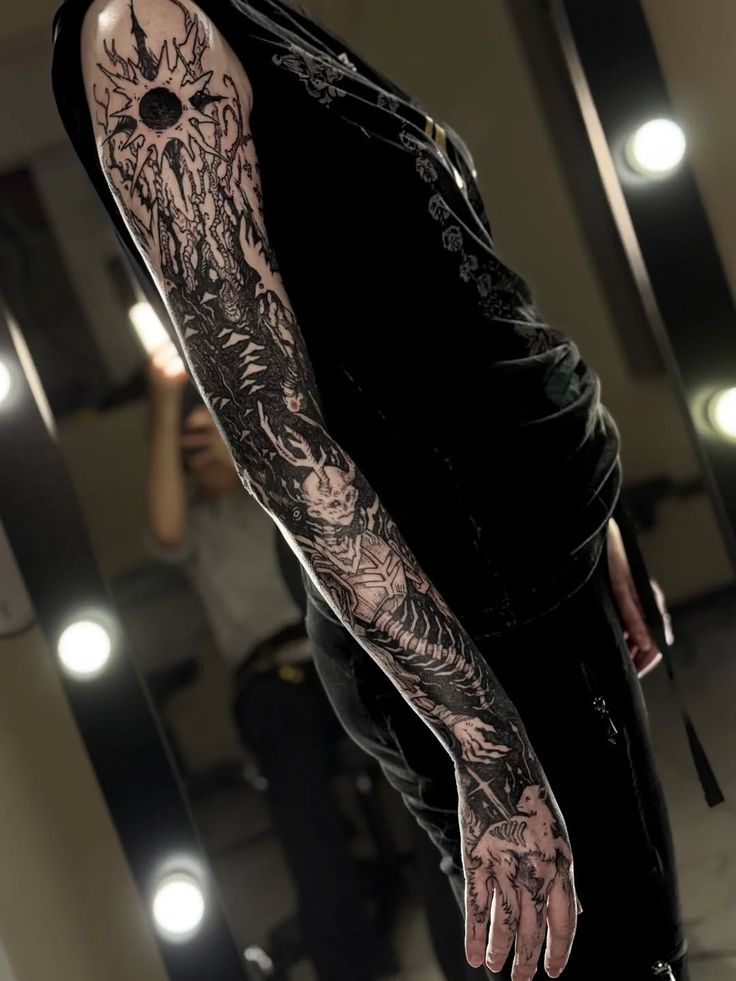
Gothic literature’s most enduring archetype — the vampire — offers a rich, complex vocabulary of imagery for a dark romance sleeve. This isn’t about B-movie horror; it’s about the seductive, melancholy beauty of the vampire as a symbol of immortality, forbidden desire, and the blurred line between life and death.
A sleeve in this genre might center on a Dracula-esque figure emerging from shadow, cape billowing, with bats spiraling outward across the arm. Alternatively, the concept can be made more abstract and elegant: a pale throat with two crimson puncture marks, dripping roses, crumbling castle architecture glimpsed through mist, and a blood-red moon rising above it all. The drama here comes from contrast — deep black shadows against pale, almost luminous skin tones.
Red accents used strategically against an otherwise monochromatic palette create an exceptionally striking visual effect. This is one of the more theatrical goth sleeve concepts, perfectly suited to those who love gothic fiction and want their body art to tell a story with cinematic intensity.
6. Occult Sigils and Sacred Geometry Sleeve
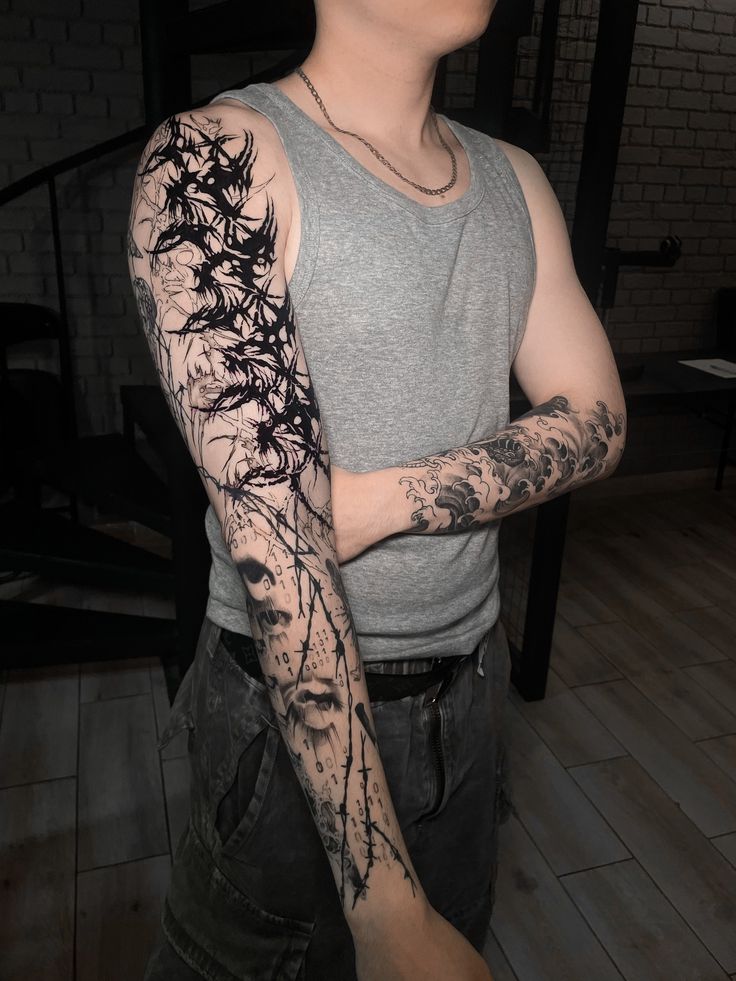
For those drawn to esoteric traditions, ceremonial magic, and the visual language of the occult, a sigil and sacred geometry sleeve can be extraordinarily powerful. Pentagrams, the Eye of Providence, alchemical symbols, Hermetic diagrams, and planetary seals all carry centuries of meaning and create a visual language that feels both arcane and intentional.
This sleeve works beautifully as a highly structured, symmetrical design — a complex geometric mandala or alchemical wheel at the center, with sigils and symbols radiating outward in an organized, almost ritualistic arrangement. The elbow is an excellent placement for a circular mandala focal piece, with geometric linework extending both up and down the arm.
The style choice matters enormously here: precise geometric blackwork creates a sleek, almost architectural quality, while adding organic elements like botanical illustrations or smoke tendrils softens the rigidity and grounds the design in something more naturalistic. This sleeve rewards viewers who understand the references — it’s a deeply layered, intellectually rich piece of body art.
7. Dark Botanical and Poisonous Plants Sleeve
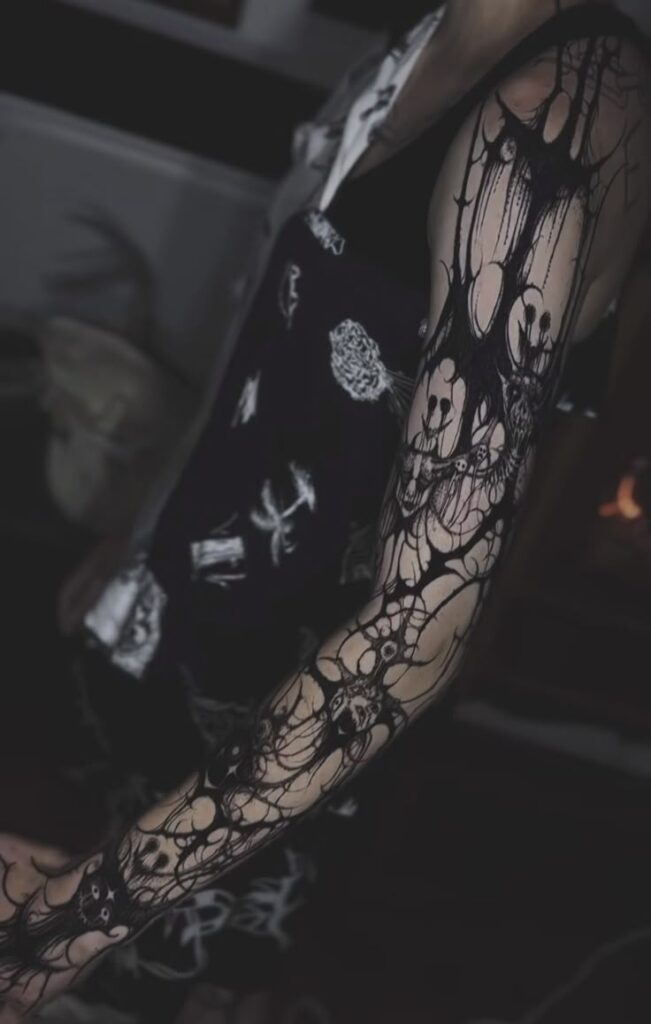
Gothic botanicals have surged in popularity, and it’s easy to understand why. There’s a specific breed of dark beauty in plants associated with poison, death, and the macabre — belladonna, hemlock, mandrake, oleander, and nightshade carry a sinister elegance that feels perfectly suited to gothic sleeve design.
A dark botanical sleeve might be executed in the style of a Victorian scientific illustration gone beautifully wrong: precise linework with Latin nomenclature, detailed root systems and seedpods, but rendered in deep blacks and greys with heavy shading that transforms botanical accuracy into something deeply atmospheric. Skulls nestled within petals, moths resting on deadly flowers, and snakes coiling through branches are natural companions to this concept.
This sleeve pairs brilliantly with the Victorian mourning theme mentioned earlier, or it can stand fully on its own as a statement piece about the beauty found in dangerous things. For anyone exploring goth back tattoo designs, dark botanicals can extend seamlessly from sleeve to shoulder blade in one unified composition.
8. Gothic Skull and Roses Sleeve
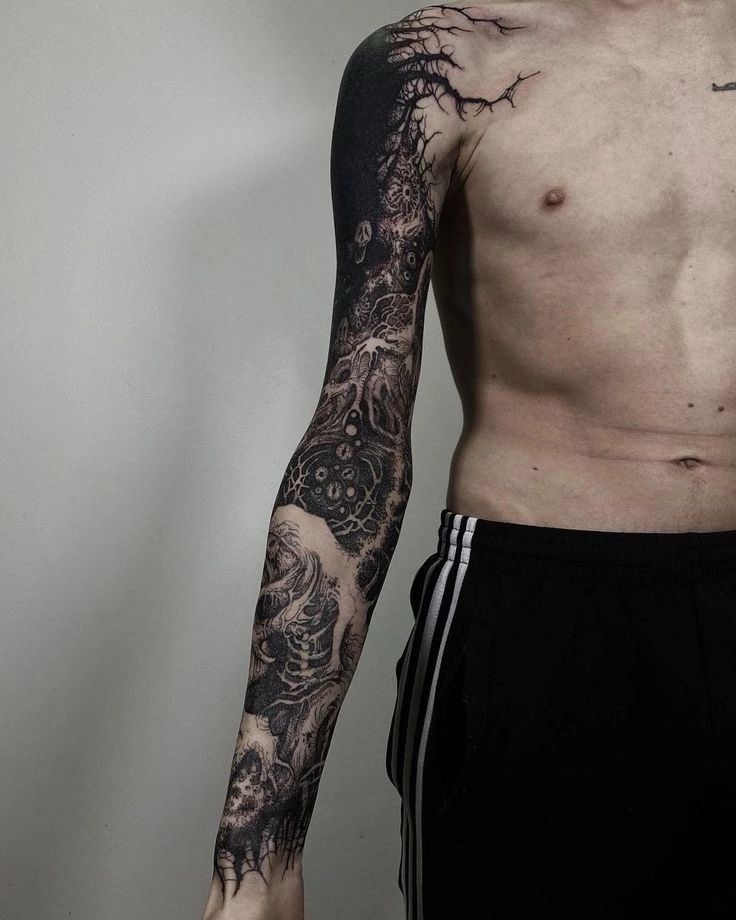
The skull-and-rose combination is one of tattooing’s oldest and most beloved motifs, but in the hands of a skilled goth-influenced artist, it transcends cliché entirely and becomes something genuinely striking. The pairing is philosophically loaded: the rose represents love, beauty, and fleeting life; the skull represents death and impermanence. Together, they embody the bittersweet truth that beauty and mortality are inseparable.
A gothic take on this classic might feature hyper-realistic roses in full bloom and roses in full decay — petals dropping, edges blackening — intertwined with skulls whose surfaces are cracked, aged, and mossy. Executed in deep black and grey with subtle negative space highlights, the contrast between organic softness and hard bone creates a visually arresting sleeve that rewards close inspection.
The beauty of this concept lies in its scalability and adaptability. It can be refined and elegant or raw and visceral, minimal or densely packed, and it flows naturally around the arm’s curves. A skilled artist will treat this as a serious artistic challenge rather than a template — the result is timeless rather than trendy.
9. Crow and Dead Forest Sleeve
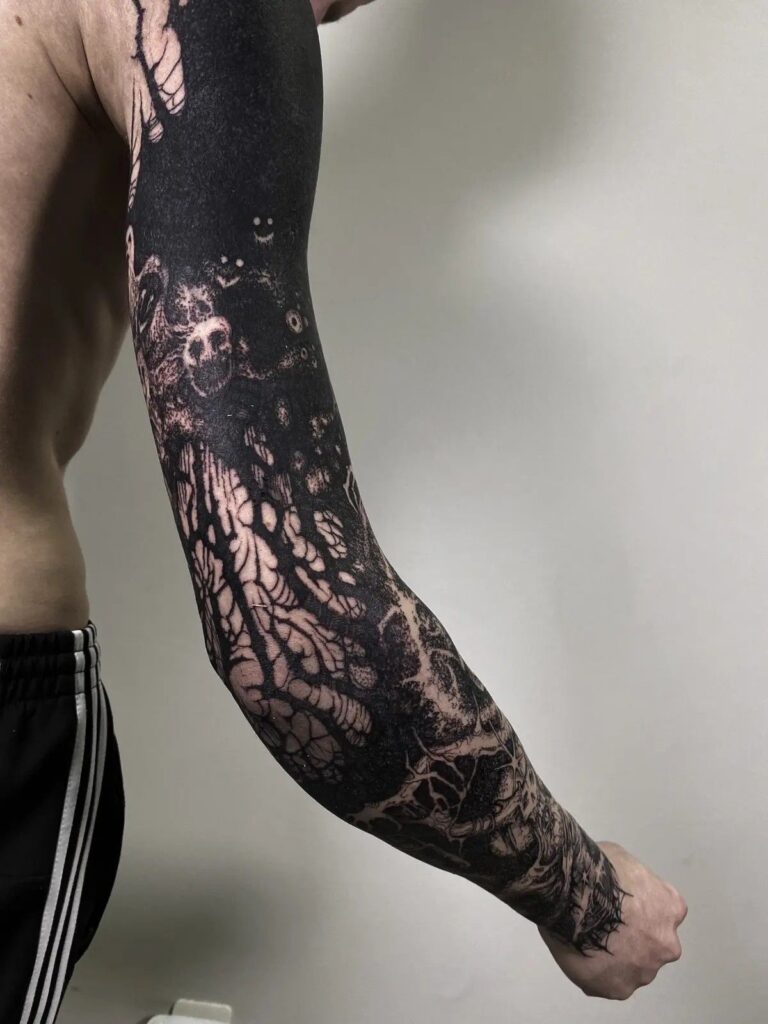
Where the raven carries literary mythology, the crow-and-dead-forest concept leans more toward the visual poetry of a winter landscape — bare, skeletal trees, frosted ground, a lone crow or murder of crows against a pale sky. This sleeve is quieter in tone than some others, but it carries an atmosphere that is profoundly and hauntingly beautiful.
The design might feature twisted, leafless trees climbing from the wrist to the upper arm, their branches interlocking to create a natural frame, with crows perched at intervals and a moon or setting sun visible through the canopy. A mist-covered ground plane at the wrist grounds the composition and creates a sense of depth, as if the arm is a window into a dark, still landscape.
In terms of execution, black and grey with masterful use of negative space and atmospheric shading produces the most evocative results. The sleeve should feel like a piece of fine art printmaking as much as a tattoo — something reminiscent of an Edward Gorey illustration or a 19th-century etching brought to life.
10. Gothic Horror Literature Sleeve
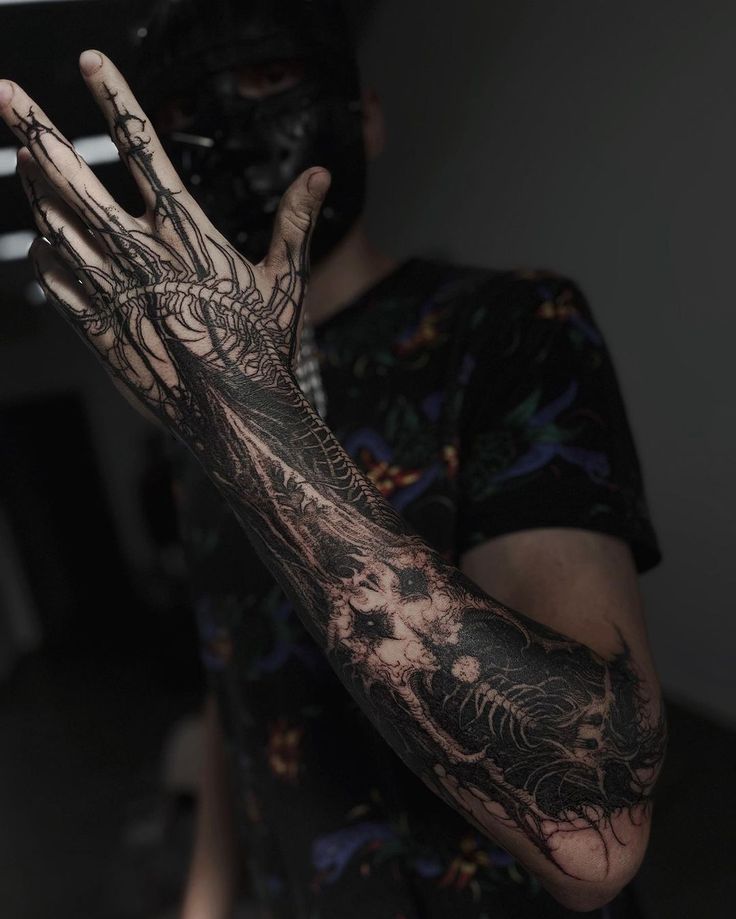
For the bookish goth, a sleeve dedicated to the canon of gothic and horror literature is a deeply meaningful choice. Think Frankenstein’s creature, the crumbling Usher mansion, the White Whale, Count Dracula emerging from Transylvania, the decaying portrait of Dorian Gray, or the swirling madness of Lovecraftian cosmic horror — all interpreted through skilled illustrative tattooing.
This sleeve can take a cohesive single-story approach or become a curated anthology of beloved literary horrors. Character portraits, architectural settings, symbolic objects — a green light across dark water, a black cat on a heap of bricks, a withered wedding cake — and thematic text excerpts all work beautifully within this concept. The arm becomes a library of darkness.
The practical tip here is to work with your artist to develop a visual hierarchy: one major piece as the anchor, secondary scenes or symbols connecting outward, and text elements used sparingly as connective tissue. The risk with a “greatest hits” approach is visual chaos — thoughtful composition keeps it unified and readable.
11. Dark Angel and Fallen Heaven Sleeve
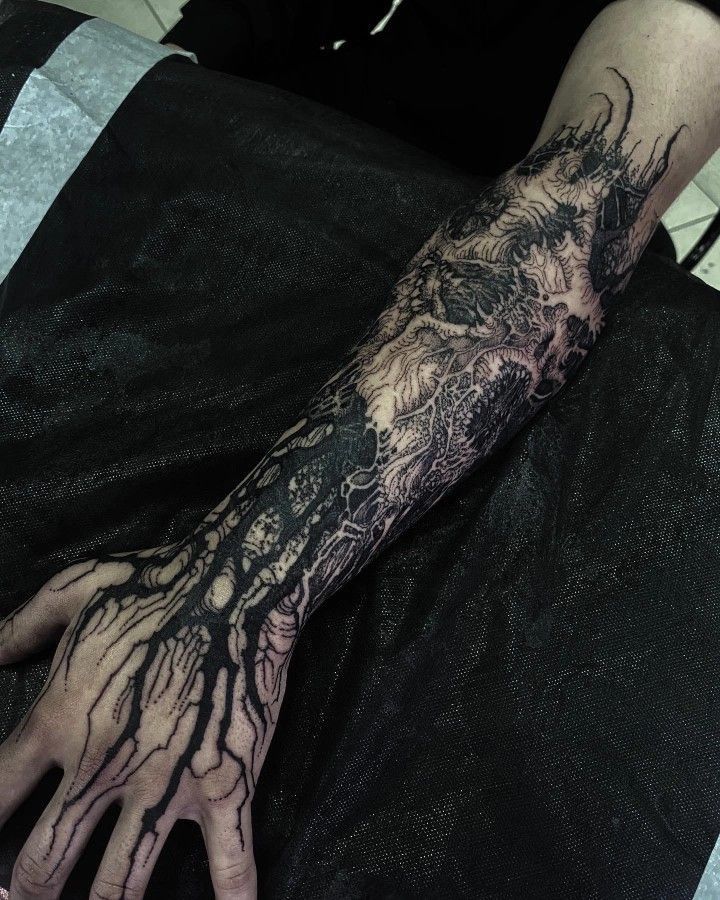
The imagery of angels in gothic art is deliberately subversive — these are not the gentle cherubs of Renaissance painting, but beings of fierce, terrifying beauty, their wings ragged, their faces expressing grief, rage, or cold indifference. The fallen angel archetype, embodied by figures like Lucifer and the rebel angels of Miltonian mythology, adds an additional layer of complex, morally ambiguous power.
A fallen angel sleeve might feature a massive winged figure on the upper arm, head bowed or turned skyward, wings spread or broken, surrounded by storm clouds, crumbling columns, and falling feathers. The scale of the wings allows them to wrap naturally around the arm, making this one of the most compositionally satisfying sleeve concepts in the gothic repertoire.
Artists who specialize in realistic figure work and dramatic lighting — the kind that makes skin appear to glow from within the tattoo — are the ideal collaborators for this concept. The emotional range is wide: this sleeve can be sorrowful, defiant, wrathful, or transcendent depending on how the figure is rendered.
12. Day of the Dead Gothic Fusion Sleeve
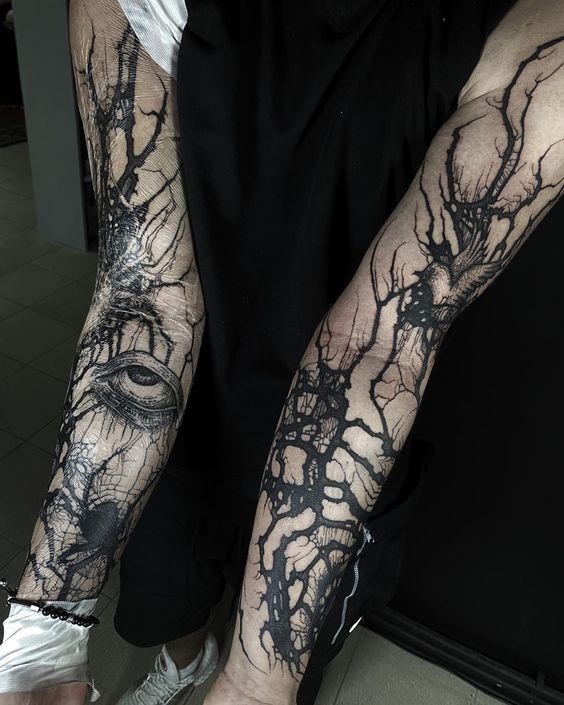
The Mexican Día de los Muertos tradition is visually spectacular on its own, but when filtered through a gothic aesthetic lens, the result is something that honors both traditions while creating a genuinely unique visual language. Sugar skulls adorned with black roses instead of marigolds, Victorian lace patterns replacing the traditional floral work, and a monochromatic palette punctuated by deep crimson or violet accents distinguish this fusion approach.
This sleeve might center on a calavera portrait — a skull-faced figure dressed in Victorian mourning attire, black lace mantilla, jet jewelry, and all — surrounded by dark botanical elements and swirling scroll-work. The blend of cultural traditions creates something that is simultaneously celebratory and melancholy, honoring the dead while acknowledging the artistry of grief across cultures.
Color choice is a decisive factor here. A full-color approach with jewel tones against black can be breathtaking, while a strict black-and-grey execution pulls the design further into gothic territory and creates an almost vintage photographic quality. Either direction works; the key is commitment and consistency.
13. Gothic Clock and Time Symbolism Sleeve
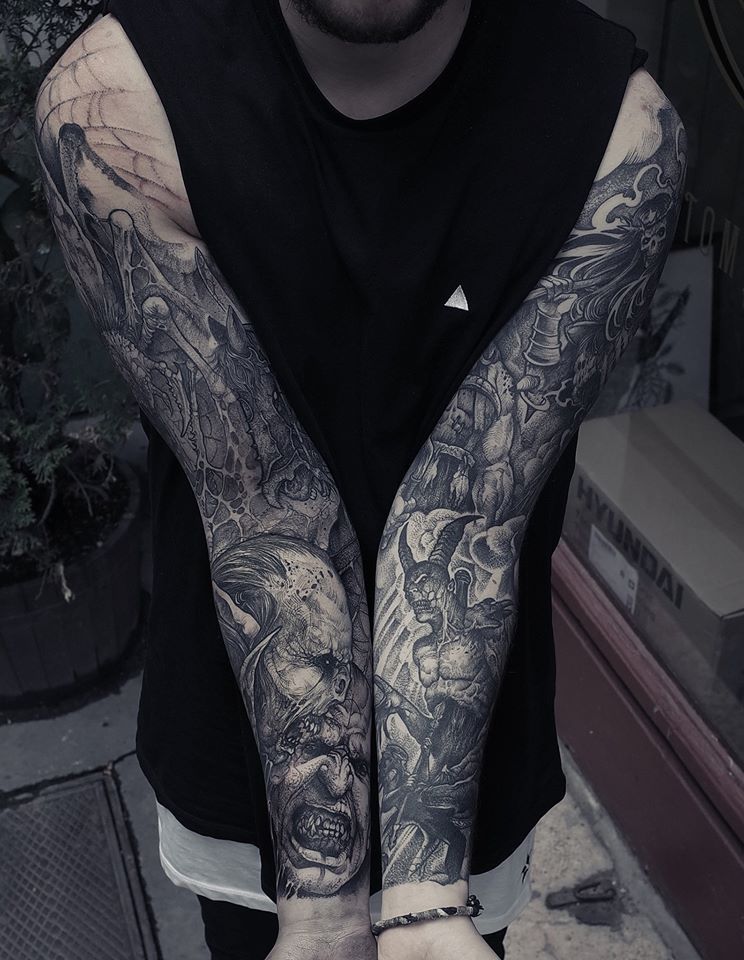
Time, decay, and the relentless march toward death are central preoccupations of the gothic tradition, and the imagery of clocks, hourglasses, and calendrical symbols gives these obsessions a visual form that is both striking and deeply philosophical. A sleeve built around time symbolism manages to be simultaneously gloomy and intellectually rich.
The concept might anchor around a large, ornate broken or melting pocket watch — its hands stopped at midnight, its case cracked and overgrown with moss or ivy — with an hourglass, dripping sand, positioned below it. Roman numerals scattered across the composition, clock gears spilling outward, moths perched on the mechanisms, and a distant tolling bell rendered as radiating lines all build a dense, layered narrative about mortality and the passage of time.
In a purely mechanical sense, this sleeve rewards a highly detailed blackwork or neo-traditional approach, where the intricacy of the clock mechanisms can be rendered with precision. The Gothic-clockpunk aesthetic also pairs naturally with Victorian elements, making this an excellent foundation if you’re planning an extended back piece or chest panel later.
14. Serpent and Dark Symbolism Sleeve
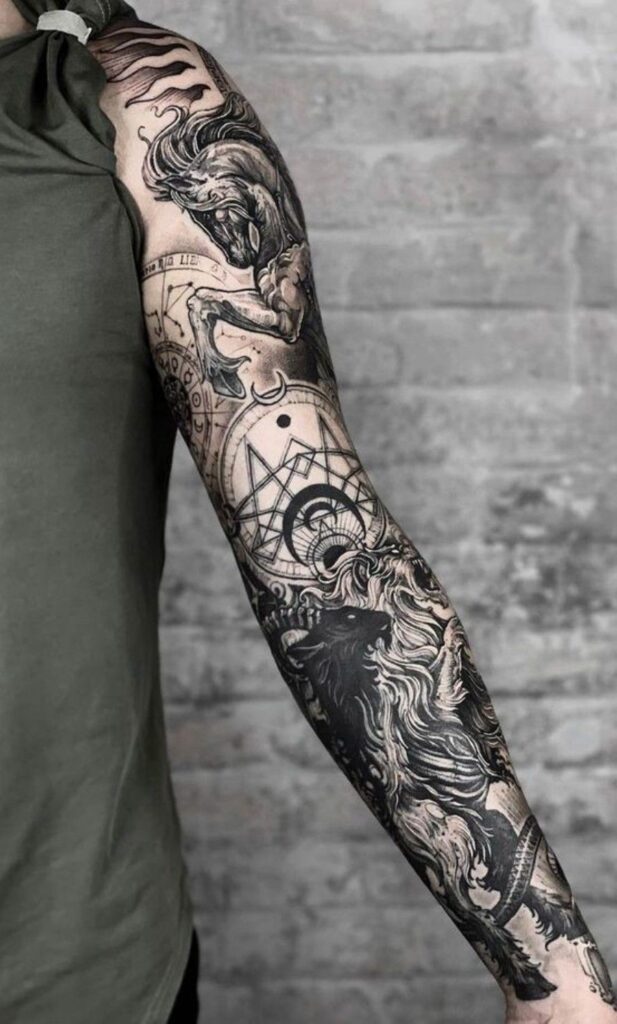
The serpent is one of the most ancient and cross-culturally resonant symbols in human history — representing temptation, transformation, forbidden knowledge, and the cycle of death and rebirth embodied by the Ouroboros, the serpent consuming its own tail. In gothic iconography, the serpent appears coiled around skulls, threaded through roses, and wrapped in esoteric diagrams, lending every composition a sense of primal, dangerous energy.
A serpent sleeve might feature a massive, highly detailed serpent winding from the wrist to the upper arm in a continuous spiral, its scales rendered with extraordinary precision, its eyes cold and intelligent. Secondary elements — an apple, a pentagram, anatomical hearts, or the jawless skull of a memento mori — can be incorporated at natural pause points within the coil.
Blackwork or dark neo-traditional are both excellent stylistic homes for this concept. The key artistic challenge is making the serpent feel alive and in motion rather than static, which requires a skilled artist who understands how to use musculature, scale patterning, and tonal contrast to suggest sinuous movement across a curved surface.
15. Dark Fantasy and Shadow Realm Sleeve
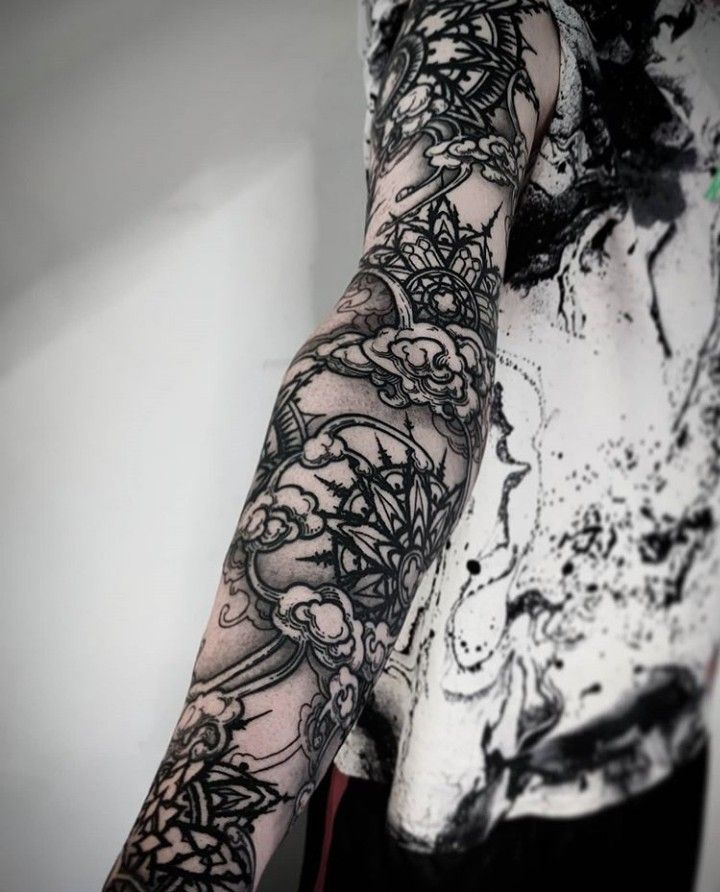
The final concept draws from the broad, imaginative territory of dark fantasy — the shadow world of fae, shadow creatures, wraiths, cursed forests, and forbidden magic that literature and visual art have populated with spectacular inventiveness. This is the most creative and personally customizable of all goth sleeve concepts, because it invites the wearer and artist to build a world together from scratch.
A dark fantasy sleeve might feature a hooded figure walking a path through a forest of bone-white trees, fireflies made of skulls lighting the way, a crumbling tower visible in the background, and shadow creatures — part smoke, part wing — swirling at the edges of the composition. The sense of narrative is paramount: this sleeve should look like a single frame from a story that extends far beyond the edges of the arm.
Style-wise, this concept thrives in illustrative blackwork or ink-wash-inspired tattooing that mimics the quality of fantasy book illustration. The design benefits from a strong sense of atmospheric perspective — foreground elements in deep, solid black fading to lighter, finer linework in the distance — to create genuine depth and immersion.
How to Choose the Right Goth Sleeve Tattoo
With so many extraordinary directions available, the challenge isn’t finding inspiration — it’s narrowing down your vision into something cohesive and personally meaningful. A few practical principles can help.
Start with symbolism, not just aesthetics: The most resonant tattoo sleeves are built on concepts that mean something to the wearer. Ask yourself which gothic symbols, themes, or stories have genuinely moved you, frightened you, or felt personally significant. That emotional core is what will make a sleeve feel meaningful ten years from now.
Think about style before subject: Black and grey realism, blackwork, neo-traditional, illustrative, and geometric approaches all produce very different results even with identical subject matter. Research artists whose style genuinely excites you — the right artist for your vision is as important as the design itself.
Plan for the full canvas: A sleeve is a compositional challenge. The upper arm, inner arm, elbow ditch, forearm, and wrist all have different visibility, sensitivity, and shape. Work with your artist to develop a layout that treats the whole arm as a unified composition rather than a collection of individual pieces.
Commit to a cohesive visual language: Mixing too many styles or themes within a single sleeve creates visual noise. Choose a tonal and stylistic direction early — whether that’s darkly romantic Victorian, raw occult geometric, or atmospheric dark fantasy — and stay faithful to it throughout the piece.
Give it time: The best sleeves are built over multiple sessions, sometimes spanning years. Resist the urge to rush. A sleeve planned and executed with patience will be something you treasure forever.
Conclusion
Gothic sleeve tattoos are more than body art — they’re a declaration of identity, a philosophical statement, and an ongoing creative conversation between the wearer and the artist. Whether you’re drawn to the literary darkness of Victorian mourning traditions, the raw power of occult symbolism, the quiet melancholy of dead forests and winter crows, or the theatrical grandeur of fallen angels and dark fantasy, there is a sleeve concept here that can become genuinely, uniquely yours.
The gothic aesthetic has always been about finding beauty in darkness, meaning in mortality, and art in the spaces that polite society prefers not to examine. Your sleeve is an opportunity to carry that vision with you wherever you go — visible, permanent, and entirely your own.
Find the imagery that moves you. Find an artist whose skill and passion match your vision. Then commit fully to creating something extraordinary. The darkness, as it turns out, is full of breathtaking things.