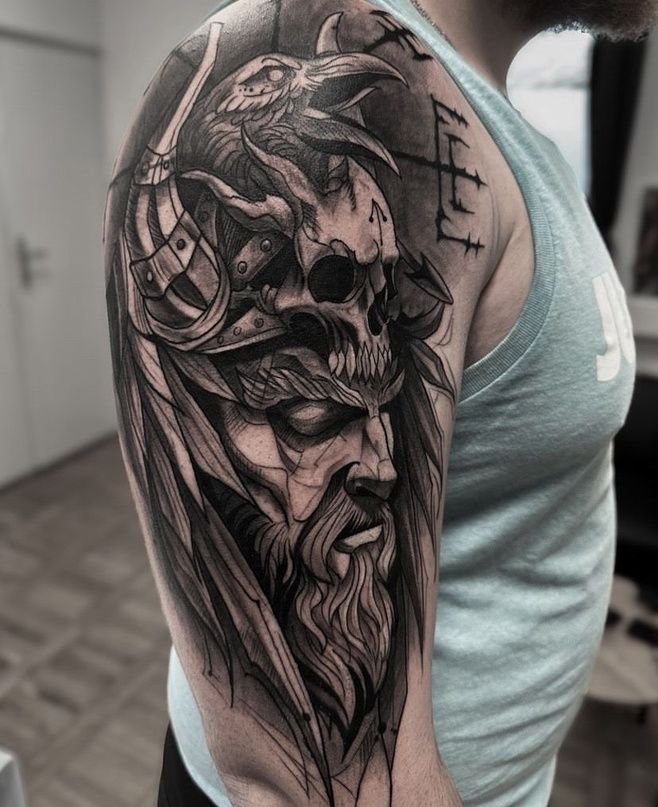
A shoulder cap tattoo covers the rounded dome of the deltoid muscle, sitting like a short sleeve that stops somewhere between the collarbone and the middle of the upper arm. The name comes from the shape it creates on the body, since the design sits over the shoulder the way a cap sits over a head.
It is one of the few placements that reads as complete on its own while still leaving obvious room to grow. That double life is a large part of why artists and collectors keep coming back to it.
The shoulder also happens to be one of the more forgiving areas to tattoo. There is muscle and soft tissue under the skin, the surface does not sit directly over bone for most of the area, and friction from clothing is low compared with hands, feet, or the inner arm.
Those conditions matter over the long term. Tattoos placed here tend to hold their edges and shading well for years, provided the work is done properly and protected from sun exposure.
There is a design advantage too. The deltoid is a curved, three-dimensional surface, and artwork drawn to follow that curve gains a sense of motion that the same design would never have on a flat panel of skin.
A composition that wraps the cap looks different depending on whether someone is standing in front of the wearer, behind them, or off to the side. Shoulder tattoo designs that ignore this and sit flat on the front of the arm rarely feel as resolved.
There is also the practical question of visibility. A shoulder cap piece disappears under a t-shirt sleeve and appears in full under a tank top, which makes it easy to control who sees it and when. Readers weighing that trade-off may find it useful to compare with other discreet placements in this guide to tattoo ideas that stay hidden when you want them to.
The 11 ideas below run from delicate botanical work to heavy blackwork, and each section covers the design concept, how it should sit on the curve of the deltoid, the visual effect it produces, and who tends to gravitate toward it. Practical notes on sizing, session length, and future expansion appear where they are relevant.
1. Floral Shoulder Cap With a Central Bloom
A floral shoulder cap usually starts with one dominant flower placed at the highest point of the deltoid, with smaller blooms, buds, and leaves radiating outward from it. Peonies, roses, magnolias, and dahlias all work well because their layered petals already suggest depth.
The reason this composition sits so well on the shoulder is structural. A large round flower echoes the round shape of the muscle, so the tattoo and the body are telling the same visual story rather than competing.
From there, the supporting elements do the framing. Stems and leaves fan down the outer arm and taper toward the bicep, which draws the eye downward and makes the arm look longer rather than shorter.
Artists often push a few petals over the top of the shoulder toward the trapezius and let one or two drop toward the chest. That small amount of wraparound is what separates a floral shoulder tattoo that looks designed for the body from one that looks stuck on.
This idea suits people who want something substantial without heavy black saturation. It reads as soft at a distance and detailed up close, which gives it broad appeal across ages and dress codes.
Size is flexible. A tight cluster covering the top third of the deltoid can be finished in one session, while a full cap with trailing botanicals typically needs two or more. Those drawn to delicate botanical work may also want to look at how similar linework behaves on a larger canvas in this breakdown of fine-line botanical tattoos for women.
For anyone considering a sleeve later, florals are among the easiest starting points. Additional flowers, foliage, or filler can extend down the arm almost indefinitely without the original piece looking like an afterthought.
2. Ornamental Mandala Medallion
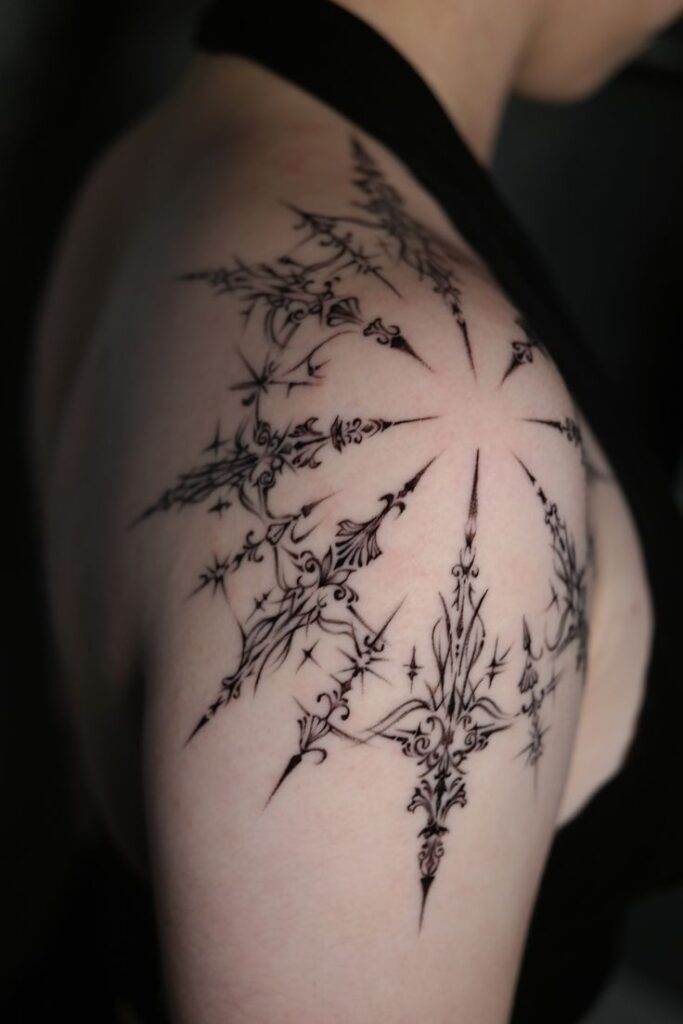
An ornamental cap treats the shoulder as a decorative plate rather than a picture. The design is built from repeating geometry: concentric rings, petal shapes, dot gradients, lace patterning, and fine radial linework fanning out from a central point.
Placement here is unusually precise. The center of the mandala is normally set at the crown of the deltoid, and the rings expand outward from there so the pattern appears symmetrical from every viewing angle.
That symmetry is also the hard part. Because the shoulder curves in two directions at once, a stencil drawn flat will distort badly, so the artist has to redraw or freehand sections directly on the skin with the arm in a neutral position.
The finished effect is closer to jewelry than illustration. It suggests an epaulette or a piece of armor plating, and it gives the shoulder a defined edge that makes the upper arm look more structured.
Ornamental work appeals to people who like pattern and order more than imagery, and to anyone who wants a tattoo that does not carry an obvious narrative. It is also a common choice for those who want visual impact without a subject that could date.
Dotwork shading is standard in this style, laid down in gradients that soften the outer rings into the skin. That softening is what keeps the edge of the cap from looking like a hard line drawn across the arm.
One practical note: dense dotwork takes time. A detailed ornamental cap often runs across multiple sessions, and the fine dot gradients need careful sun protection to stay crisp.
3. Geometric and Sacred Geometry Cap
Geometric shoulder caps use straight lines, arcs, and repeated shapes to build a composition that feels engineered. Common elements include nested triangles, hexagonal grids, segmented arcs, and thin parallel line fields.
Unlike ornamental mandalas, geometric work does not always aim for radial symmetry. Many pieces are deliberately asymmetrical, with a dense cluster of shapes on the outer deltoid thinning into scattered fragments toward the chest and back.
Following the curve matters more here than almost anywhere else. Straight lines on a curved surface will appear to bend, so artists either accept that bend and design around it or break the lines into shorter segments that read as straight from the main viewing angle.
The visual result is clean and modern. Geometric work tends to sharpen the appearance of the shoulder, emphasizing the deltoid’s edges and giving the arm a more defined silhouette.
This style draws people who want a graphic look without figurative imagery, and it is a frequent pick among those who describe their taste as minimal but still want good coverage. It also photographs well, which matters to some.
Linework precision is everything. Wobbly lines and uneven spacing show immediately in geometric tattoos, so it is worth reviewing an artist’s healed geometric work rather than fresh photos before booking.
Geometric caps connect to sleeves easily because the vocabulary is modular. Shapes can be repeated down the arm at different scales, and negative space between them prevents the sleeve from becoming visually heavy.
4. Japanese Wave and Cloud Shoulder Cap
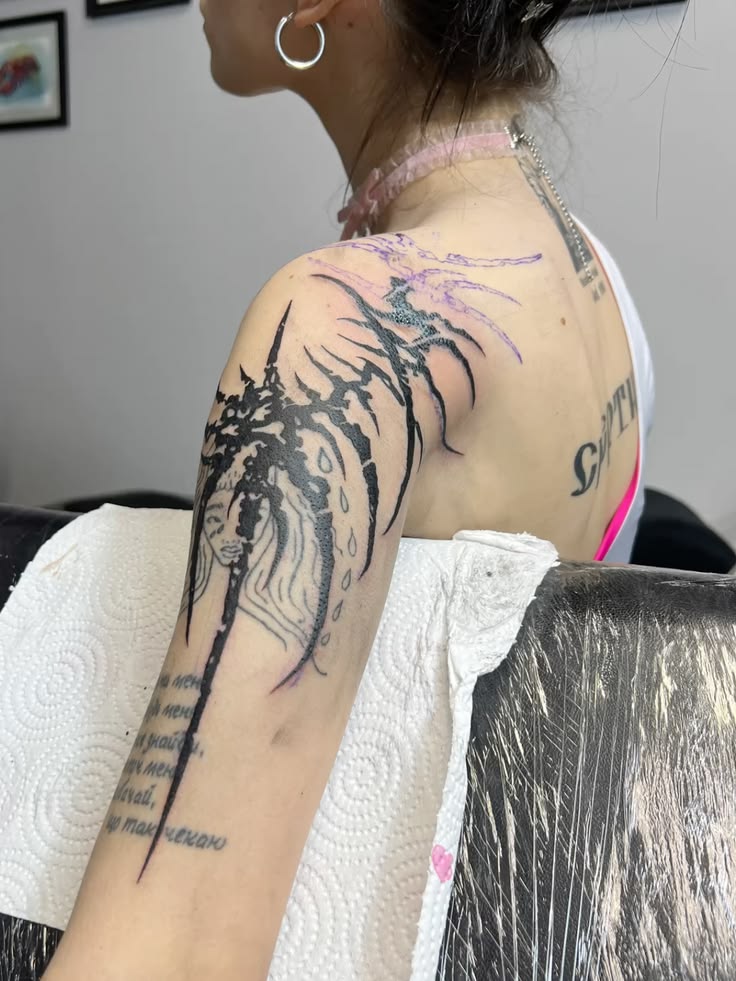
Traditional Japanese tattooing has been solving the shoulder problem for centuries, and its solutions still hold up. A Japanese-style cap typically uses stylized waves, wind bars, or cloud forms as the background structure, sometimes with a koi, dragon, or blossom worked into the composition.
The background is not filler in this style. Waves and clouds are drawn to flow around the deltoid in curved bands, and that flow is what gives the tattoo its sense of movement when the arm shifts.
Japanese work also comes with a built-in framing convention. The edges of the design are finished with a defined border of background elements rather than fading out, which produces a clean, deliberate boundary at the sleeve line.
The effect on the arm is substantial. Bold outlines and heavy black backgrounds make the shoulder look broader and more solid, which is part of why this style is so common in shoulder tattoo ideas for men.
That said, the style is not restricted by gender at all, and cherry blossom or chrysanthemum-led compositions read considerably softer than dragon-led ones.
Anyone drawn to this style should plan for scale. Japanese tattooing relies on bold lines and large forms, so cramming the style into a small area removes most of what makes it work. A cap piece in this tradition usually covers the full deltoid at minimum.
It is also the most sleeve-ready option on this list. Japanese sleeves are designed around continuous background flow, so a properly built cap can extend to the elbow and wrist years later without redrawing anything.
5. Polynesian-Inspired Blackwork Cap
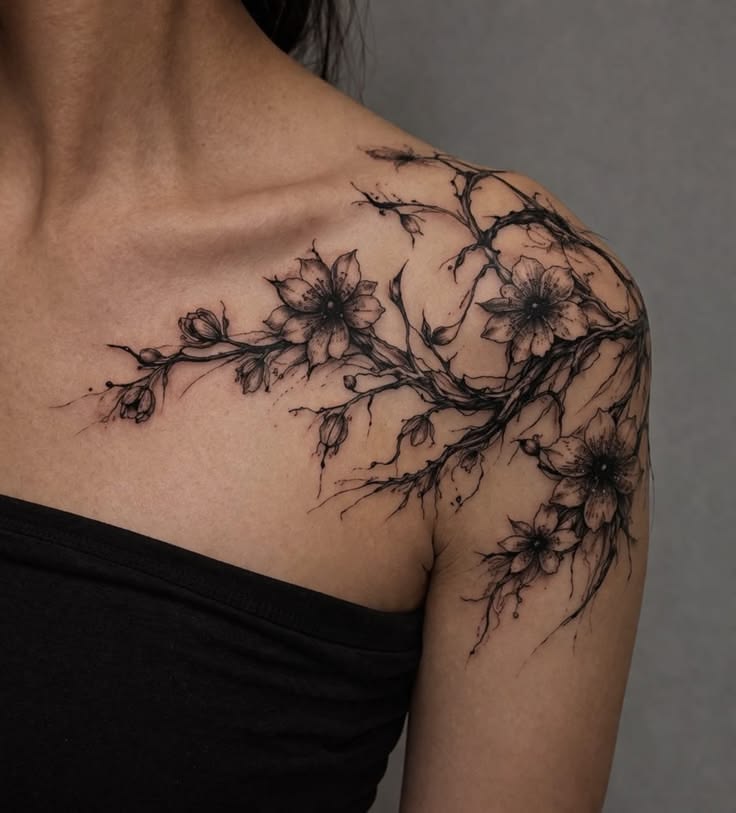
Polynesian and Polynesian-inspired designs are built from dense black pattern bands, and the shoulder is one of the traditional locations for this kind of work. Patterns are arranged in panels that follow the muscle rather than sitting across it.
The structure normally involves several distinct pattern bands separated by thin negative-space channels. Those channels are what keep a solid black design from turning into an undefined mass at a distance.
On the curve of the deltoid, the bands compress slightly at the edges and widen at the crown, and a skilled artist uses that compression to reinforce the roundness of the muscle.
The visual result is bold and high-contrast. Solid black against skin creates the strongest possible definition, and the tattoo stays legible from across a room in a way that fine-line work does not.
This appeals to people who want presence rather than detail, and to those who like the graphic weight of blackwork. Anyone interested in the broader blackwork vocabulary can see how similar heavy linework functions across other placements in this collection of gothic flash tattoo designs.
One important consideration involves cultural context. Authentic Polynesian designs carry specific meanings tied to family, status, and origin, and many artists working in this field distinguish carefully between genuine cultural work and inspired-by patterning. It is a conversation worth having directly with the artist before the stencil is drawn.
Solid black also demands serious aftercare and sun discipline. Large black areas take longer to heal and will lose depth quickly if exposed to strong sun during the first year.
6. Blackwork Armor Plate or Pauldron
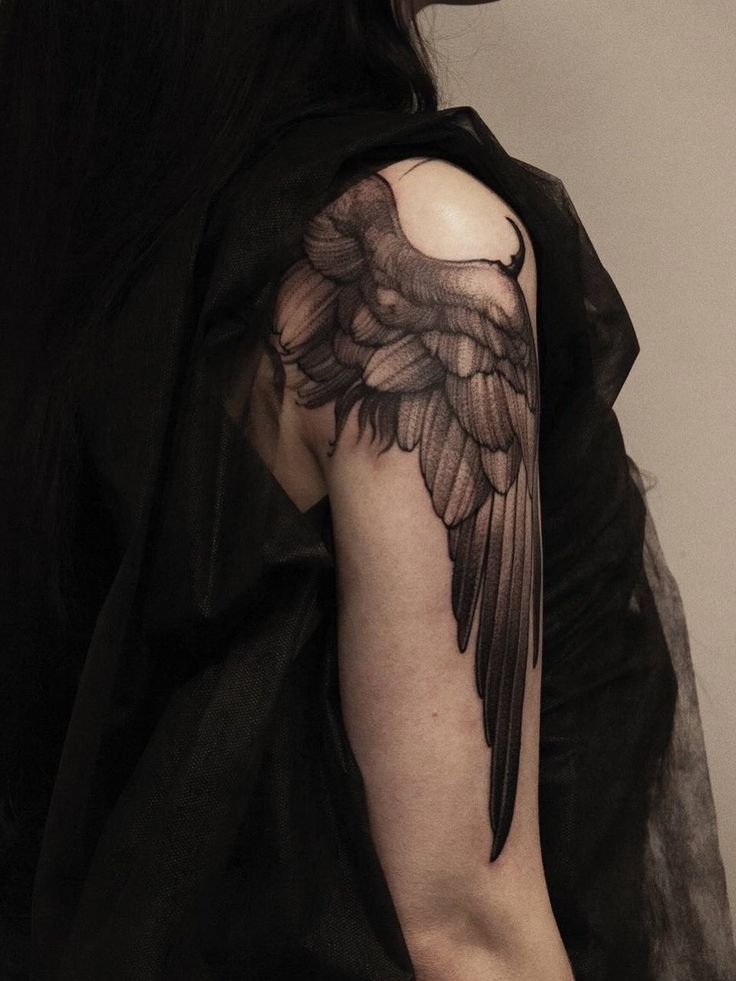
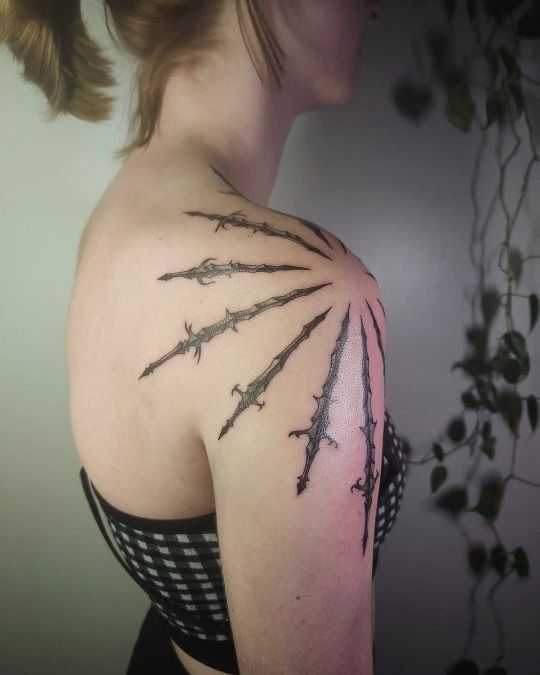
The armor-plate concept takes the shoulder cap idea literally. The tattoo is designed to look like a piece of protective plating resting on the shoulder, with rivets, segment lines, wear marks, and shadow rendering.
Realistic shading is what sells this design. The artist uses gradient black and grey to suggest curved metal catching light, which means the shading has to be planned around the actual shape of the wearer’s shoulder.
Because the illusion depends on the body’s contours, this design cannot be copied from a photograph and applied unchanged. It has to be adapted to the individual, which is a point worth raising during the consultation.
The effect is dramatic. A well-executed pauldron makes the shoulder look heavier and more defined, and the hard edge at the bottom of the plate creates a very clean sleeve line.
This suits people drawn to fantasy, historical, or biomechanical themes, and it is a strong option for anyone who wants a design with an obvious concept rather than an abstract pattern.
Size should be generous. Detailed metal rendering needs room for the gradients to work, and a small version tends to lose the illusion entirely and read as a grey blob.
Extending this into a sleeve usually means continuing the mechanical theme down the arm, with articulated segments at the elbow and forearm plating. It is a commitment, but the concept scales cleanly.
7. Animal Portrait Anchored on the Deltoid
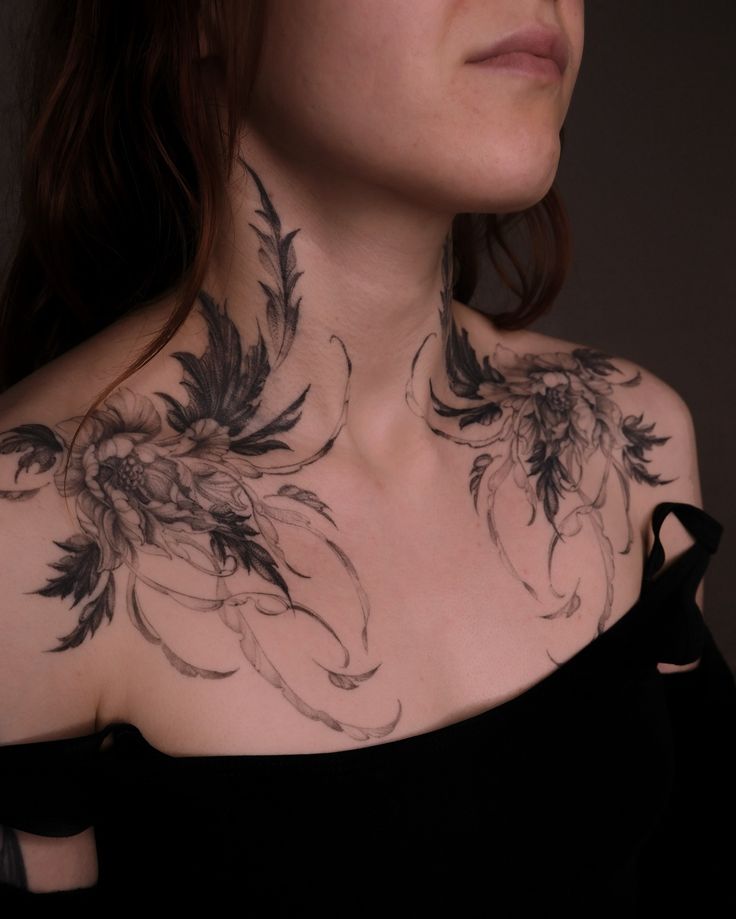
Animal-led shoulder caps place a single strong subject on the deltoid, most often a lion, wolf, bear, tiger, stag, or bird of prey. The head is typically positioned at the outer point of the shoulder where it is most visible from the side.
Composition here requires some planning. A portrait placed straight on the front of the arm will only look correct from directly ahead, so artists usually angle the subject so it faces slightly forward and downward.
Supporting elements fill the rest of the cap. Fur or feather texture, foliage, geometric backing, or smoke fades outward from the subject and softens the transition to bare skin.
The visual effect depends heavily on the animal and the rendering. A black-and-grey realism lion with heavy contrast projects weight and scale, while a fine-line stag with botanical framing reads far quieter.
This idea suits people who want a tattoo with clear personal meaning attached to it. Animal symbolism is direct and widely understood, which is exactly the appeal for some and the drawback for others.
Detail level is the main practical consideration. Realism requires fine tonal transitions, and those need both space and an artist who works specifically in that style. Portraits also benefit from occasional touch-ups over the years to keep contrast strong.
A well-planned animal cap works as a sleeve anchor because the subject becomes the focal point, with everything added below it acting as supporting environment.
8. Celestial Sun, Moon, and Star Cap
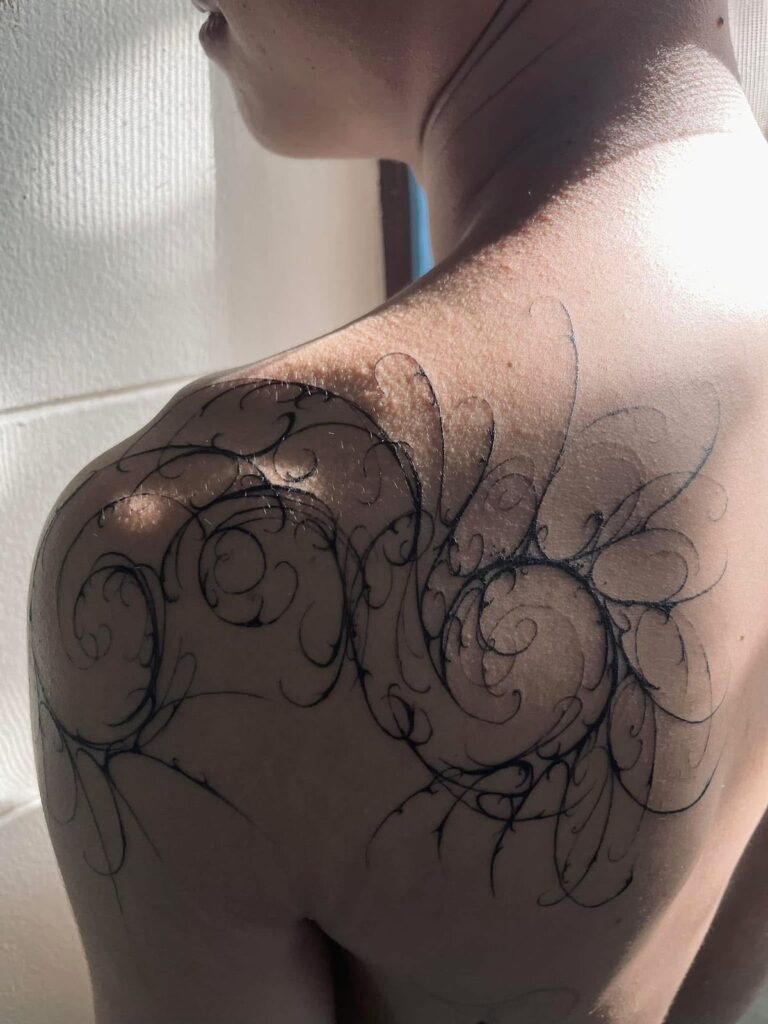
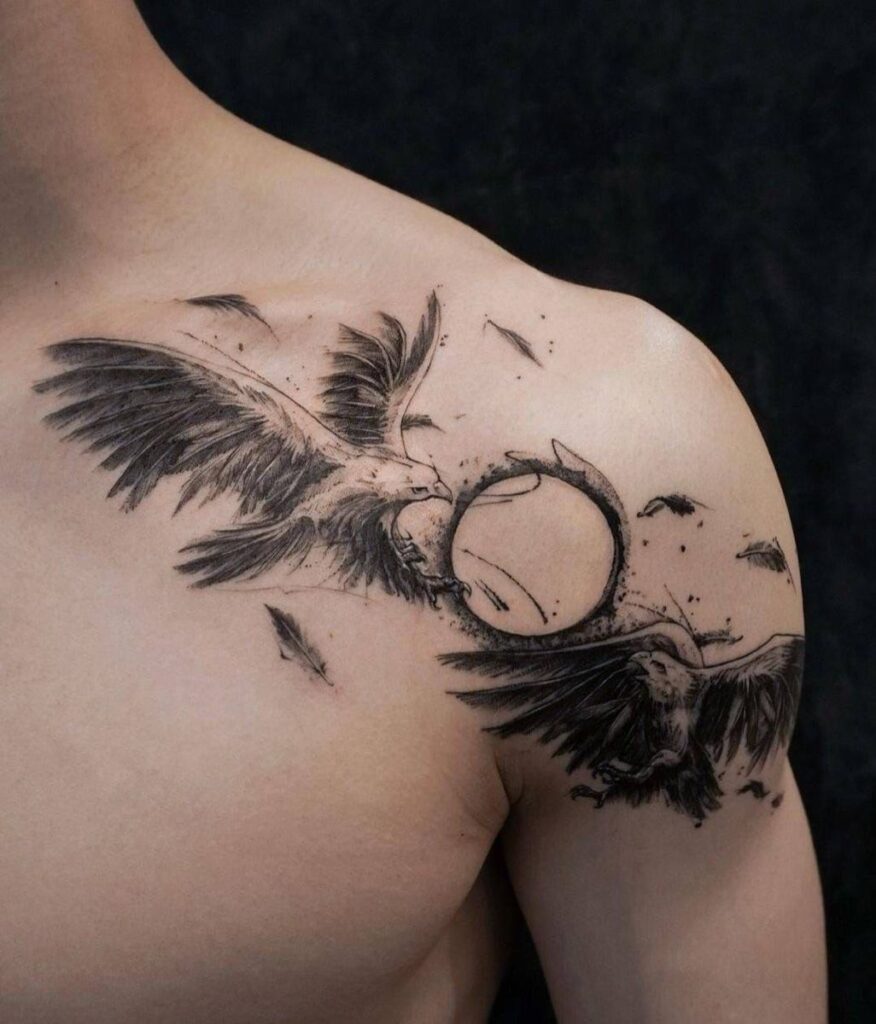
Celestial shoulder caps use the sun, moon phases, constellations, and star fields as their core imagery. The circular nature of these subjects makes them a natural fit for the round surface of the shoulder.
A common arrangement places a sun or full moon at the crown of the deltoid, with rays, phases, or stars radiating outward. Because the central subject is already a circle, it mirrors the shoulder’s shape directly.
Another approach runs the moon phases in an arc that follows the curve of the deltoid from front to back. That arc emphasizes the roundness of the shoulder and produces a design that reveals itself gradually as the wearer turns.
The effect can be soft or bold depending on execution. Dotwork star fields and thin ray lines produce a quiet, atmospheric look, while heavy black negative-space suns create strong graphic contrast.
Celestial designs attract people who want symbolism that is meaningful but open to interpretation. Cycles, change, and guidance are common associations, and none of them are tied to a specific culture or trend.
Sizing is unusually flexible. A single crescent with a few stars can occupy a small patch of the upper deltoid, while a full cosmic scene with nebula shading can cover the entire cap and spill onto the chest.
For future expansion, celestial work connects well with landscape, botanical, or ornamental additions, since night-sky imagery sits comfortably above almost any subject.
9. Fine-Line Botanical Drape
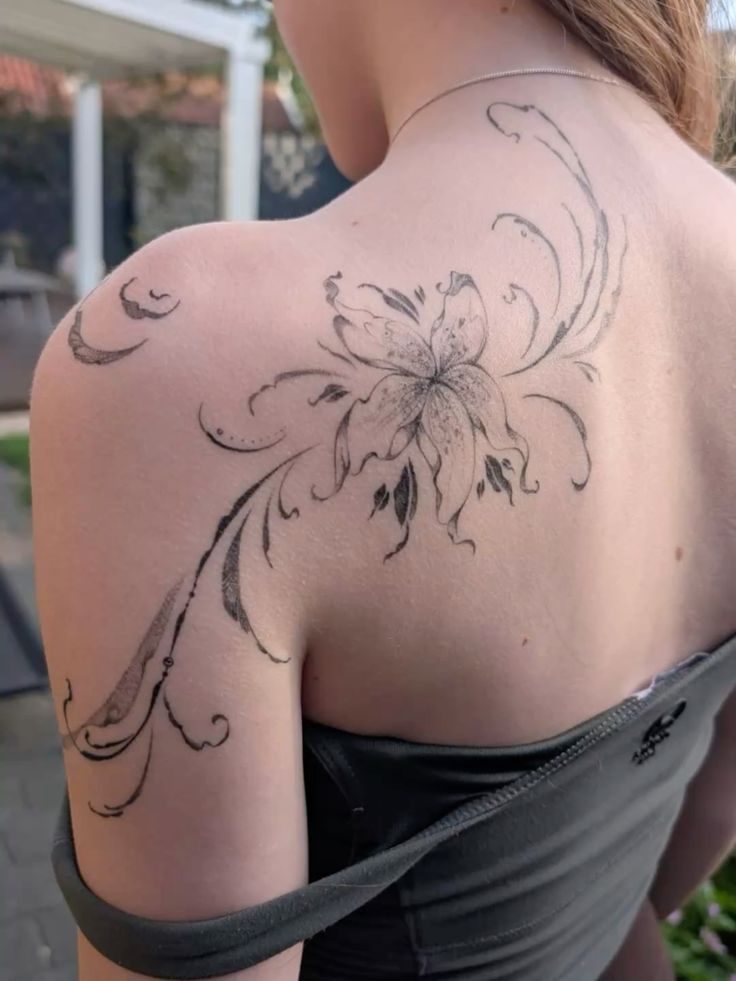
Not every shoulder cap needs to be dense. A fine-line drape uses thin, delicate linework to create the impression of botanical strands falling over the shoulder, like vines or a lace shawl laid across the skin.
The design usually starts near the top of the shoulder and flows downward in a loose, uneven curtain. Density is highest at the top and thins as it descends, which mimics how fabric actually falls.
That gradient is the key to the effect. An even distribution of elements across the whole cap looks like wallpaper, while a thinning gradient looks like something draped over the body.
The result is light and airy. From a distance, the tattoo reads as texture rather than as a defined image, and it gives the shoulder a softened outline instead of a sharpened one.
This appeals to people who want coverage without visual weight, and it is one of the more popular directions within shoulder tattoo ideas for women. It also works well for people whose workplaces require sleeves most days.
There are trade-offs worth knowing. Fine lines carry less pigment than bold lines and tend to soften more over time, so this style generally needs touch-ups sooner than heavy blackwork. Skilled artists will space lines slightly wider than a drawing would suggest to allow for that spread.
Anyone leaning minimal may also want to see how restrained linework performs in smaller compositions, which is covered well in this set of small chest tattoo ideas with meaning.
10. Script and Ornament Banner Arc
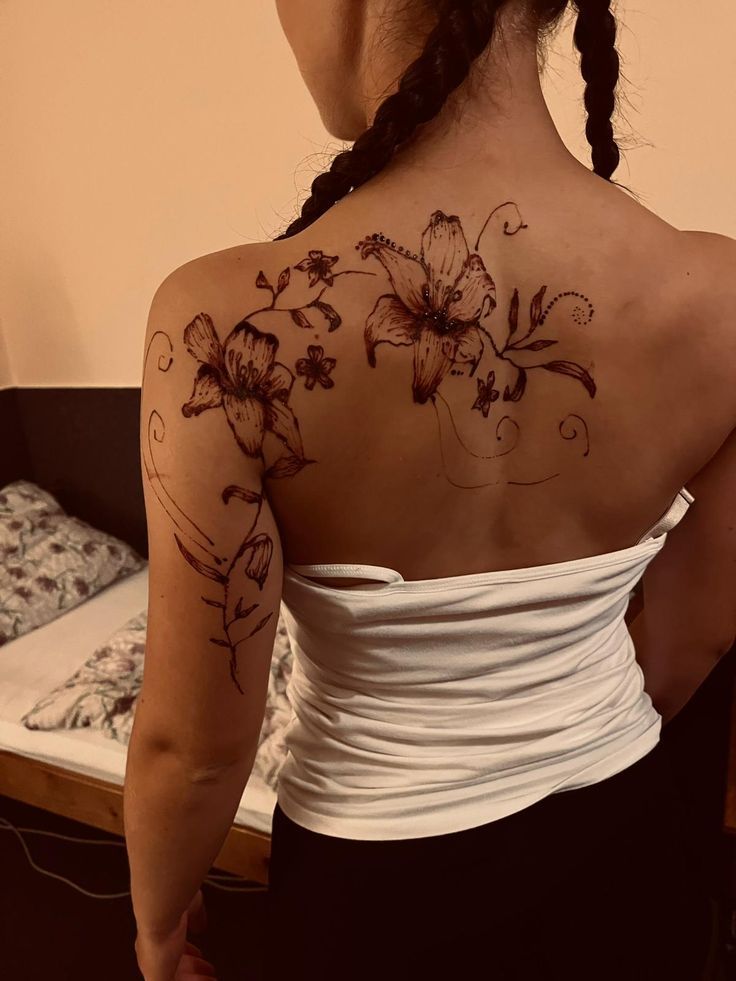
Lettering on the shoulder works best when it follows a curve rather than sitting in a straight line. A script cap uses a phrase, name, or date arranged in an arc that traces the top edge of the deltoid, usually paired with ornamental flourishes or small illustrative elements.
The arc does two useful things. It keeps the text readable from the front while allowing the design to wrap naturally, and it creates an implied frame around the rest of the shoulder.
Letter size needs care. Text that is too small will blur as it ages, particularly in scripts with fine connecting strokes, so most artists recommend a minimum letter height and a typeface with enough weight to survive.
Placement on the curve affects legibility directly. Text that crosses the steepest part of the deltoid will appear compressed from some angles, so the arc is normally positioned across the flatter upper section.
This design suits people whose tattoo is primarily about the words themselves, such as a memorial, a family name, or a personal motto. The ornamental elements exist to support the text rather than compete with it.
Pairing matters here. Script alone on a large shoulder tends to look sparse, so most artists add filigree, small botanicals, or a subtle background texture to give the composition body.
If a sleeve follows later, the script arc can act as a header, with imagery below it building downward. Keeping the text at the top prevents it from being crowded by later additions.
11. Abstract Watercolor and Brushstroke Cap
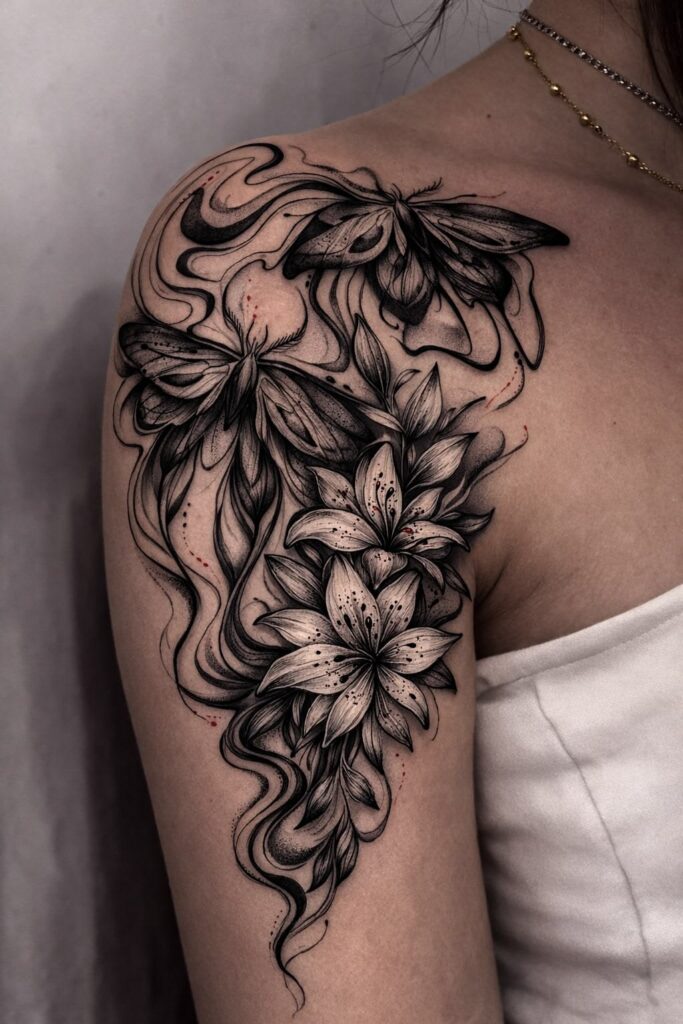
Abstract shoulder caps drop representational imagery entirely in favor of color fields, brushstroke marks, splatter, and soft blended washes. Some include a faint line-drawn subject underneath, while others are purely non-figurative.
Composition follows the muscle in a looser way than other styles. Strokes are usually laid in diagonal sweeps that travel from the top of the shoulder toward the outer arm, reinforcing the direction the deltoid naturally slopes.
The soft, undefined edges are what make this style feel like something applied to the skin rather than drawn into it. When those edges are deliberately irregular, the tattoo looks more like paint and less like a shape.
The visual effect is the loosest on this list. There is no hard sleeve line, no defined boundary, and the tattoo appears to dissolve into the surrounding skin.
People drawn to this style usually want something expressive and personal that does not announce a specific meaning. It also works well as a cover-up direction, since color washes can absorb older work.
Longevity deserves an honest mention. Watercolor tattoos without any black anchoring tend to soften noticeably over the years, and lighter pigments fade faster than dark ones. Many artists now build a subtle black or dark-toned skeleton underneath the color to hold the shape long-term.
This style connects to sleeves less predictably than the others, since abstract work does not have obvious continuation rules. Anyone planning a future sleeve should discuss it before the first session rather than after.
How to Choose the Right Shoulder Cap Tattoo
The most useful starting question is not which design to pick but what the tattoo needs to do. A piece intended to stand alone forever is designed differently from one intended as the top of a sleeve.
Standalone caps benefit from defined edges and a clear boundary, so they read as finished. Sleeve anchors benefit from open edges and flowing background elements that give a future artist something to build from.
Lifestyle is the second filter. People who spend time in professional settings with short sleeves may want the design to sit higher on the deltoid so a standard t-shirt covers it completely.
Skin tone and contrast are worth discussing openly with an artist. Certain colors and fine gradients read differently on different skin tones, and a good artist will adjust palette and line weight accordingly rather than applying a one-size approach.
Budget and time also shape the decision. A full ornamental or Japanese cap represents several sessions and a meaningful cost, while a fine-line drape or small celestial piece can often be completed in one sitting.
Finally, there is the question of taste over time. Designs built on pattern, botanicals, and traditional styles have tended to age well across decades, while trend-driven imagery carries more risk. Browsing a broad range of styles before committing helps, and Tattoo Dreams Today collects placement guides and style inspiration across most of the categories mentioned here.
Best Tattoo Styles for Shoulder Cap Designs
Some styles were effectively built for curved surfaces, and they perform noticeably better on the shoulder than others.
Styles That Suit the Curve Naturally
Traditional Japanese leads this group because its entire compositional logic is based on flowing background forms that wrap the body. Neo-traditional follows closely, since its bold outlines and stylized shapes hold up on any surface.
Ornamental and mandala work is also a strong fit, as radial designs echo the round shape of the deltoid. Polynesian-inspired blackwork belongs here too, given that it is traditionally arranged in bands that follow muscle groups.
Illustrative black and grey adapts well because the artist can adjust composition freely rather than working within a rigid style convention.
Styles That Need More Planning
Hyper-realism can work on the shoulder, but distortion is a real risk. A realistic face or object drawn flat will warp on a curved surface, so the artist must compensate during the drawing stage.
Geometric work faces the straight-line problem described earlier and requires either careful segmentation or a deliberate acceptance of curvature.
Fine-line minimalism works aesthetically but carries longevity trade-offs on any placement, and the shoulder’s sun exposure during summer months makes protection more important than people expect.
Matching Style to Existing Tattoos
Anyone with existing arm tattoos should think about stylistic consistency before adding a cap. Mixing a photorealistic shoulder with traditional forearm work is possible, but it usually requires a transitional element to avoid a disjointed look.
Consistency does not mean identical subjects. It means shared line weight, shading approach, and color palette, which is what actually makes separate tattoos read as one body of work.
Shoulder Cap Tattoo Placement and Sizing
The boundaries of a shoulder cap are a design decision rather than a fixed rule, and where they land changes the whole look.
Where the Design Should Start and Stop
The upper boundary usually sits near the acromion, the bony point at the top of the shoulder, sometimes extending slightly onto the trapezius. Going further up the neck changes the piece from a cap into a shoulder-and-neck composition.
The lower boundary is the more consequential choice. Stopping at the deltoid insertion, roughly a third of the way down the upper arm, produces a short-sleeve look. Extending to mid-bicep creates something closer to a quarter sleeve.
The front and back edges determine how much the tattoo wraps. A cap that stops at the front edge of the deltoid stays invisible from the front in most clothing, while one that reaches onto the chest becomes far more prominent.
Getting the Sleeve Line Right
A hard, straight edge at the bottom of a cap tends to look artificial, because nothing on the human body ends in a straight horizontal line. Most artists angle the lower edge slightly, following the natural diagonal of the deltoid insertion.
Some designs avoid a defined edge entirely, fading out through scattered elements, dot gradients, or thinning linework. This approach is generally easier to extend later.
Sizing Expectations
A minimal cap covering the top portion of the deltoid might measure four to five inches across. A full cap covering the whole muscle commonly runs eight inches or more in both directions once the wrap is accounted for.
Because the surface curves, the actual skin area is larger than a flat measurement suggests. This surprises people when quotes come in, and it is a fair thing to ask an artist to explain during consultation.
How Shoulder Movement Affects the Design
The shoulder is the most mobile joint in the body, and a tattoo placed there will be viewed in many different positions.
The skin over the deltoid stretches and compresses as the arm raises, rotates, and reaches across the body. A design that looks balanced with the arm hanging down may appear stretched with the arm raised.
Experienced artists account for this by stencilling with the arm in a neutral, relaxed position, then checking the design with the arm raised and rotated before starting. Asking whether they plan to do this is a reasonable question.
Designs with organic, flowing forms handle movement far better than rigid ones. Waves, foliage, and brushstrokes absorb distortion because there is no fixed reference shape to compare against.
Faces, text, and precise geometric grids are the most vulnerable. A portrait can look subtly wrong when the arm is lifted, which is one reason many artists place portraits on the flatter outer deltoid rather than the crown.
The rear of the shoulder deserves a mention as well. Skin over the posterior deltoid moves significantly when the arm crosses the chest, so heavily wrapped designs need their rear elements positioned with that motion in mind.
Black-and-Grey vs. Color Shoulder Cap Tattoos
Both approaches work on the shoulder, and the choice comes down to the effect wanted and the maintenance accepted.
The Case for Black and Grey
Black and grey holds contrast longer than most color palettes, which means the design stays legible as it ages. Grey wash also blends smoothly into bare skin, which makes soft-edged caps easier to execute.
It is the standard for realism, Japanese-influenced work, blackwork, and ornamental designs. It also pairs with anything added later, since black never clashes with a future color palette.
Healing tends to be more straightforward too, particularly compared with heavily saturated color that requires more passes over the same skin.
The Case for Color
Color brings separation and energy that black and grey cannot match. Floral caps in particular gain a great deal from color, since petal tones carry information that grey wash flattens.
Traditional and neo-traditional styles rely on color as part of their identity, and removing it changes the style rather than simply changing the palette.
The trade-off is maintenance. Color generally requires more diligent sun protection, and lighter tones such as yellow, pale pink, and white fade faster than deep reds and blues.
Mixed Approaches
A common compromise uses black-and-grey structure with selective colour accents, such as a black-and-grey botanical cap with one bloom in colour. This keeps the piece durable while still giving it a focal point.
Another approach adds color later. Starting in black and grey and adding color in a follow-up session is entirely workable, though it should be planned from the start rather than decided afterward.
How to Connect a Shoulder Cap Tattoo With an Arm Sleeve
Many shoulder cap tattoos eventually become the top of a shoulder sleeve tattoo, and the transition goes far more smoothly when it is planned early.
Plan the Full Arm Before the First Session
Even a rough plan helps. Knowing the intended theme, style, and general composition of a future sleeve lets the artist leave the cap’s lower edge open in useful places.
This does not require committing to specific imagery. It mainly requires deciding on a style and a general direction, such as black and grey botanical or traditional Japanese.
Use Background as the Connector
Background elements do most of the work in a successful transition. Waves, clouds, smoke, foliage, and texture fields carry the eye from the shoulder down the arm without a visible seam.
Tattoos built as isolated images with clean borders are the hardest to extend, because the border itself becomes a barrier that a later artist has to work around or cover.
Watch the Bicep and Inner Arm
The upper arm narrows below the deltoid, so a design that is wide across the shoulder needs to taper. Failing to account for this makes the arm look top-heavy.
The inner bicep is also more sensitive and tends to hold ink slightly differently from the outer arm, which is worth discussing when planning how far around the arm the sleeve will wrap.
Staying With One Artist
Where possible, keeping the same artist for the cap and the sleeve produces the most cohesive result. When that is not possible, a detailed set of photographs and a clear description of the original plan helps the next artist match line weight and shading approach.
Collectors building themed sleeves sometimes plan around a specific subject or series, and the same logic applies whether the theme is botanical, mythological, or drawn from something like these anime-inspired tattoo ideas that frequently run from shoulder to forearm.
Aftercare Considerations for Shoulder Cap Tattoos
Shoulder placement brings a few specific aftercare factors that differ from other locations.
Clothing friction is the main one. Shirt sleeves, bra straps, backpack straps, and seat belts all cross the shoulder area, and rubbing on a healing tattoo can pull away scabs and lift pigment.
Loose clothing during the first week or two solves most of this. Anyone who carries a bag on that shoulder should switch sides for the duration of healing.
Sleeping position matters more than people expect. Side sleepers who rest on the tattooed shoulder may find the area sticking to bedding or healing unevenly, so switching sides for the first week is worth the inconvenience.
Sun exposure is the long-term issue. Shoulders catch direct overhead sun more than almost any other part of the arm, and repeated exposure is the single largest cause of faded tattoos. Once healed, high-factor sunscreen on the area is the most effective thing anyone can do to protect the work.
Standard aftercare applies otherwise: keep the area clean, follow the artist’s washing and moisturising instructions, avoid picking, and skip swimming pools, baths, and saunas until fully healed.
Large caps in solid black or dense colour may take longer to settle than lighter work, and some patchiness during healing is normal. Touch-ups are commonly offered by artists after the tattoo has fully healed, usually a month or more after the session.
Frequently Asked Questions About Shoulder Cap Tattoos
Does a shoulder cap tattoo hurt a lot?
The shoulder is widely considered one of the more tolerable tattoo placements. The deltoid has good muscle coverage and relatively few concentrated nerve endings compared with ribs, hands, or the inner arm.
Discomfort increases toward the top of the shoulder where the skin sits closer to bone, and where the design wraps toward the armpit or inner arm. Pain varies considerably between individuals, so these are general tendencies rather than guarantees.
How long does a shoulder cap tattoo take?
It depends entirely on size and style. A simple fine-line or small celestial piece may take two to four hours, while a full ornamental, Japanese, or realism cap often runs across two to four sessions of several hours each.
Artists will give a realistic estimate during consultation once the design and size are settled.
Can a shoulder cap tattoo be covered by normal clothing?
Usually, yes. A cap that stops at the deltoid insertion sits under most short-sleeve shirts, though the bottom edge may show with shorter sleeves.
Designs that wrap onto the chest or extend toward the neck are harder to conceal, so anyone who needs full coverage should discuss the boundaries before the stencil is applied.
Is a shoulder cap tattoo a good first tattoo?
It can be, though size is the consideration rather than placement. The shoulder is a comfortable area to sit through, but a full cap is a large first commitment in both time and cost.
Starting with a smaller composition on the upper deltoid and expanding later is a common and sensible route.
Do shoulder cap tattoos age well?
Generally, yes. Low friction and good muscle support work in the placement’s favor, and tattoos here tend to hold their shape better than those on high-movement areas like hands and feet.
Sun exposure is the main threat. Consistent sunscreen use makes a substantial difference over a decade or more.
Can a shoulder cap tattoo work as a cover-up?
Often, yes. The size of the area gives a cover-up artist room to work, and styles with heavy black or dense pattern are particularly effective at obscuring older work.
The feasibility depends on the existing tattoo’s darkness and size, so this requires an in-person assessment rather than a photo consultation.
What is the difference between a shoulder cap and a half sleeve?
A shoulder cap stops somewhere on the upper arm, usually between the deltoid insertion and mid-bicep. A half sleeve extends from the shoulder to the elbow.
A cap is often the first stage of a half sleeve, which is why the two are so frequently discussed together.
Should both shoulders be tattooed?
That is entirely personal. Some people prefer symmetry and tattoo both shoulders in matching or complementary designs, while others deliberately keep one arm bare for balance.
There is no design rule here, though matching two caps closely requires an artist comfortable working symmetrically across the body.
Final Thoughts on Choosing a Shoulder Cap Tattoo
The shoulder cap remains one of the most practical placements in tattooing. It offers a large, forgiving canvas, straightforward concealment, good longevity, and an obvious route toward a larger sleeve whenever the wearer is ready.
The 11 ideas covered here span most of what the placement can do, from dense blackwork and ornamental patterning to fine-line botanicals and abstract colour. Each one works because it respects the shape of the deltoid rather than ignoring it.
The most important decision is usually not the subject but the plan. Knowing whether the piece will stand alone or grow into an upper arm tattoo project shapes the edges, the style, and the composition from the very first line.
Beyond that, the choice of artist matters more than any design reference. Someone who has demonstrably worked on curved placements and can show healed results will produce better work than a perfect reference image handed to the wrong person.
Anyone in the research stage should take their time, collect references across several styles, and bring that collection to a consultation. A good artist will take those ideas and adapt them to the specific shoulder they are working on, which is what turns a good reference into a tattoo that fits the body.