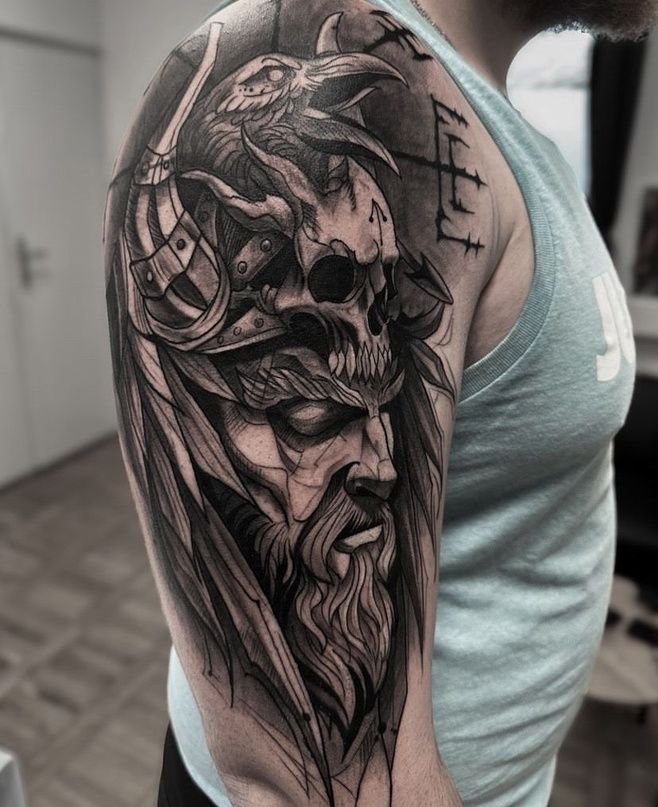
A forearm sleeve tattoo is a large-scale design that wraps around the arm between the wrist and the elbow, sometimes stretching further to connect with the shoulder. Unlike a single small tattoo, it treats the whole limb as one canvas, with each element flowing into the next.
Forearm sleeves have become one of the most requested forms of body art for men, and it’s easy to see why. The forearm is visible, muscular, and naturally shaped for storytelling, whether that means rolling up a sleeve at work or letting the ink speak for itself on a summer day.
Part of what makes a forearm sleeve tattoo look intentional rather than random is how well it follows the arm’s natural lines. The curve of the muscle, the taper toward the wrist, and the bend of the elbow all affect how a design should be laid out.
This article walks through 13 forearm sleeve tattoo ideas for men, covering a wide range of styles, from black-and-grey realism to Japanese-inspired art, geometric patterns, mythology, and more. Each idea includes guidance on placement, coverage, and how to keep the whole piece looking cohesive.
1. Black-and-Grey Realistic Lion Portrait Sleeve
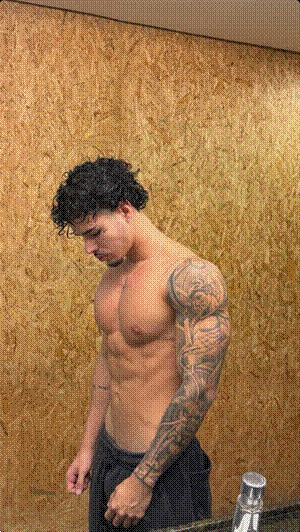
A lion portrait is one of the most requested subjects for a black-and-grey forearm tattoo, and for good reason. The animal’s face carries natural symbolism around courage and leadership, and a skilled artist can render its mane with enough depth to look almost photographic.
This design works well as a forearm sleeve because the lion’s face can sit as the focal point on the widest part of the forearm, near the elbow, where there’s enough room for the mane to spread outward. From there, the fur can taper and blend into shading that wraps around toward the wrist.
The recommended visual style leans heavily on realism, using soft gradients of grey and black rather than hard outlines. This keeps the texture of the fur looking natural rather than cartoonish.
For coverage, a single lion portrait can fill a half sleeve on its own, or it can be paired with smaller supporting elements like tribal linework or a sunburst background to extend it into a full forearm sleeve tattoo. Men who want a bolder statement sometimes add a second animal, such as a lioness or cub, lower on the arm to build out a family theme.
Because realism depends so much on shading precision, this style typically requires a tattoo artist experienced specifically in black-and-grey realistic forearm tattoo work, and sessions tend to run longer than simpler designs.
2. Japanese-Inspired Dragon and Wave Sleeve
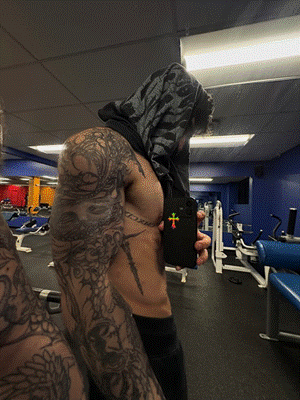
Japanese-inspired sleeves have a long tradition in tattoo culture, and the dragon remains one of the most popular central figures. In Japanese art, dragons are often shown as protective and wise rather than purely fearsome, which gives the design more depth than a simple monster motif.
The dragon’s long, sinuous body is a natural match for the forearm’s shape. The artist can coil the body around the arm in a spiral, letting the head sit near the elbow and the tail trail toward the wrist, or reverse that direction depending on personal preference.
Traditional Japanese sleeves are built in layers, with the main subject surrounded by background elements like waves, clouds, or wind bars that fill in negative space. This is what gives the finished piece its sense of movement across the whole forearm.
Visually, this style calls for bold, confident outlines with clean color blocking, even if the palette stays mostly black and grey. Some men choose to add small pops of red or blue in the waves for contrast.
A full Japanese sleeve typically covers the entire forearm, though a quarter or half sleeve version focused just on the dragon’s head and upper coils is also common for those wanting a smaller commitment. This style pairs naturally with an extended design running up toward the bicep for men who eventually want a full arm piece.
Men interested in precise linework can learn more about geometric tattoos and structured sleeve layouts.
3. Geometric Tribal Fusion Sleeve
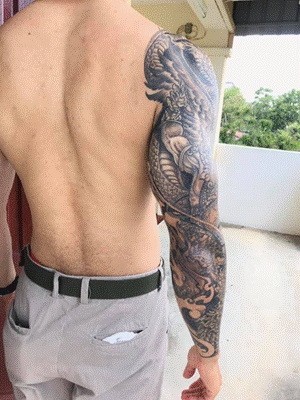
Geometric and tribal designs blend two visual languages that share a common strength: bold, graphic impact. Straight lines, triangles, and dot work sit alongside sweeping tribal curves to create something that feels both modern and rooted in older tattoo traditions.
This style works exceptionally well on the forearm because geometric shapes can be arranged to follow the arm’s contours precisely, almost like a wrap. Bands of pattern can circle the wrist, widen through the mid-forearm, and taper again near the elbow.
The level of detail here is usually high-contrast and solid black, with minimal shading. This makes the design read clearly from a distance, which is part of why it appeals to men who want a tattoo that looks striking even under a rolled-up shirt sleeve.
Because the patterns are modular, this concept extends easily. A man can start with a half sleeve of interlocking shapes and later continue the pattern up past the elbow without it looking like an afterthought.
One practical note: geometric linework demands very precise application, so it’s worth choosing an artist who specializes in this style specifically, since small inconsistencies in line weight are more noticeable in a pattern-based sleeve tattoo than in a painterly one.
4. Wolf Pack Forest Sleeve
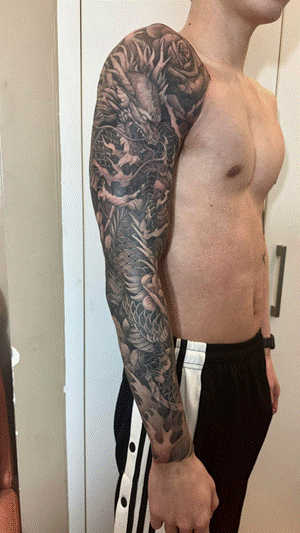
Wolves are a recurring theme in men’s sleeve tattoos because they combine strength with a sense of loyalty and pack mentality. A wolf sleeve typically goes beyond a single portrait, building out a small forest scene around the animal.
The composition often places a howling wolf’s head near the elbow, with its body and legs implied through the surrounding trees and shadows rather than drawn in full detail. This keeps the design from feeling stiff or overly literal.
Pine trees, moonlight, and mist are common supporting elements, and they double as useful transitional shading that carries the eye down toward the wrist. This is one of the more effective ways to fill a forearm without cramming in unrelated imagery.
Black-and-grey realism is the standard approach for this concept, since it captures fur texture and atmospheric depth more convincingly than flat color work. Some men add a second, smaller wolf lower on the forearm to suggest the rest of the pack.
For coverage, this idea suits a full forearm sleeve tattoo particularly well, since the forest background gives the artist room to work with negative space instead of leaving blank skin that can look unfinished over time.
5. Norse Mythology Sleeve
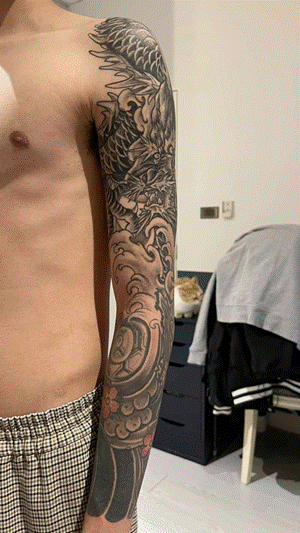
Norse mythology offers a rich pool of imagery for a forearm sleeve, including figures like Odin, his ravens Huginn and Muninn, the World Tree Yggdrasil, and various runic symbols. These elements carry weight without needing to be oversized to make an impression.
A common layout places a raven or wolf head as the anchor point near the elbow, with tree branches and roots stretching down the forearm and runes worked into the negative space between larger shapes. This mirrors how Norse knotwork traditionally interlaces.
The visual style can go one of two directions: detailed black-and-grey realism for the figures, or a more graphic blackwork approach for the knotwork and runes. Many men blend both within the same sleeve for contrast between organic and structured elements.
Because mythology-based sleeves rely on layered symbolism, it helps to plan the full composition before the first session, so the ravens, tree, and runes all sit at a scale that makes sense together rather than being added piecemeal.
This concept naturally extends toward the wrist with smaller rune clusters, or up past the elbow with additional Norse figures like Thor’s hammer, for men planning a longer-term sleeve tattoo project.
6. Botanical Blackwork Floral Sleeve
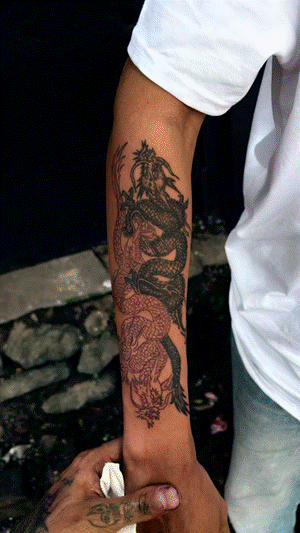
Floral tattoos aren’t only associated with women’s tattoo designs. When rendered in bold blackwork rather than soft color, botanical sleeves take on a heavier, more masculine feel that still carries all the natural detail of leaves, thorns, and layered petals.
This design suits the forearm because plant stems have a natural vertical growth pattern that mirrors the shape of the arm itself. Vines can run the length of the forearm, branching outward at the wrist and elbow where there’s more width to work with.
For visual style, thick outlines combined with solid black fill on select petals create strong contrast, while other flowers are left as linework only, which keeps the composition from feeling too dense or heavy in any one area.
Thorned roses, monstera leaves, and thistle are popular choices for a masculine botanical sleeve, since they read as more rugged than delicate garden flowers. Skulls or small animal elements are sometimes woven into the vines for extra edge.
This concept works well as either a half sleeve forearm tattoo focused on the lower arm or a full sleeve that continues the vine pattern all the way to the shoulder, making it one of the more flexible ideas on this list.
7. Skull and Pocket Watch Memento Mori Sleeve
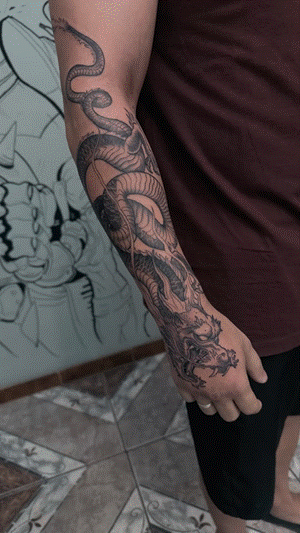
The pairing of a skull with a pocket watch is a classic memento mori composition, built around the idea that time is limited and worth appreciating. It’s a heavier theme, but the visual execution keeps it from feeling purely morbid.
The skull typically sits as the central image near the widest part of the forearm, with the watch positioned just below it, either intact or shown with a cracked face to suggest time running out. Roses or draped fabric often soften the harder edges of the bone detail.
Black-and-grey realism is the standard style here, since the goal is to make the skull and watch look tangible rather than cartoonish. Fine stippling and smooth gradients give the bone its texture and the watch its metallic shine.
This design extends naturally toward the wrist with smaller details like falling rose petals or clock gears, and toward the elbow with additional elements like a raven or hourglass for men building a larger dark-themed sleeve.
Because the subject matter is fairly dense with detail, this concept usually requires more than one sitting to complete properly, particularly if the full forearm is being covered rather than just a half sleeve.
The design can easily extend upward past the elbow joint to merge into a half sleeve tattoo for men on the upper arm.
8. Religious Iconography Sleeve
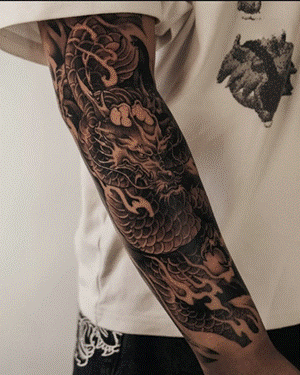
Religious and spiritual imagery remains one of the most personal categories of forearm sleeve tattoos, often chosen to honor faith, family, or a specific turning point in someone’s life. Common subjects include praying hands, rosaries, crosses, and depictions of angels.
Praying hands paired with a rosary work particularly well as a forearm centerpiece, since the vertical shape of clasped hands and hanging beads follows the natural line of the arm from elbow to wrist without needing much adjustment.
Rays of light or soft cloud shading are frequently added around the central image, which helps ground the design and gives the artist a way to blend the piece into the surrounding skin rather than leaving hard edges.
Black-and-grey realism suits this theme best, since it lends the imagery a solemn, timeless quality. Some men incorporate small text elements, like a meaningful date or a short phrase, tucked into the folds of fabric or along the rosary beads.
This concept can remain a smaller, respectful half sleeve, or expand into a full forearm sleeve tattoo by adding supporting figures such as an angel or a depiction of a religious scene above the elbow.
9. Sacred Geometry and Mandala Sleeve
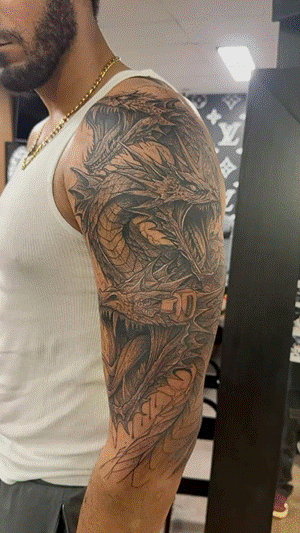
Sacred geometry and mandala designs are built entirely on pattern and symmetry rather than a central figure like an animal or portrait. Circular mandalas, interlocking polygons, and radiating lines create a hypnotic, ornamental effect.
This style is particularly well suited to the forearm because the limb’s cylindrical shape allows a pattern to wrap continuously, so that the design appears seamless when viewed from any angle rather than only looking correct from the front.
The visual approach relies on precise linework and consistent dot shading, often called dotwork, to add depth and texture without using heavy black fill. This keeps the overall look intricate rather than overwhelming.
Because mandalas are inherently symmetrical, they’re often centered around the wrist or elbow as a focal point, with smaller geometric elements branching outward to fill the rest of the forearm sleeve tattoo evenly.
This idea is a strong option for men who want something highly detailed but abstract, without personal or narrative symbolism attached. It also extends cleanly toward the upper arm using repeating geometric motifs.
10. Dark Reaper and Gothic Horror Sleeve
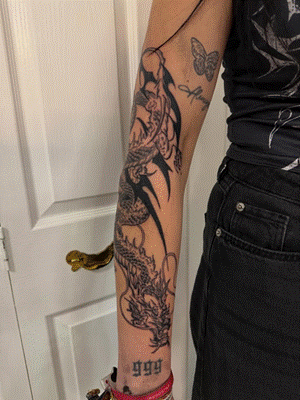
For men who want a forearm sleeve with real visual weight, dark and dramatic compositions built around a reaper or gothic horror theme deliver a striking result. The imagery leans into shadow, fog, and contrast rather than bright detail.
A hooded reaper figure typically anchors the design near the elbow or mid-forearm, with a scythe extending diagonally to guide the eye along the arm. Twisted tree branches or fog rolling through the background fill the remaining space.
This concept depends heavily on deep black shading contrasted against lighter negative space, which is what gives dark-themed sleeves their sense of depth. Flat, evenly lit designs tend to lose the intended dramatic effect.
Supporting elements like ravens, tombstones, or candle smoke can be worked in lower on the forearm to build the scene out further, keeping the storytelling consistent across the whole sleeve rather than isolated to one section.
Because the style relies on strong value contrast, it holds up particularly well over time compared to designs with subtle color gradients, making it a practical option in addition to being visually bold.
11. Minimalist Fine-Line Nature Sleeve
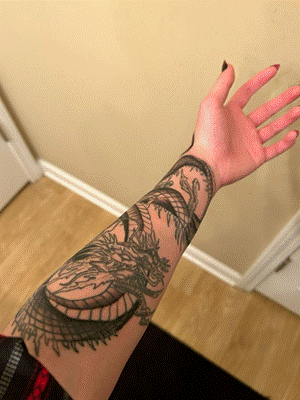
Not every forearm sleeve tattoo needs heavy shading or dense imagery. A minimalist fine-line sleeve takes a more restrained approach, using single-needle linework to sketch out small nature scenes spaced along the arm.
This concept might include a simple mountain range near the elbow, a line of pine trees further down, and a small bird or compass near the wrist, connected by thin horizon lines rather than filled backgrounds.
The appeal of this style lies in its subtlety. It reads as a full sleeve concept when viewed as a whole, but each individual element stays understated, which some men prefer over bolder black-and-grey realism.
Placement is usually planned with intentional gaps of bare skin between motifs, since fine-line work depends on negative space to stay legible rather than blending everything into one continuous image.
This idea works best as a half sleeve forearm tattoo, since fine lines can lose definition if stretched across too large an area. It’s also one of the more approachable entry points for men getting their first sleeve tattoo.
12. Neo-Traditional Snake and Dagger Sleeve
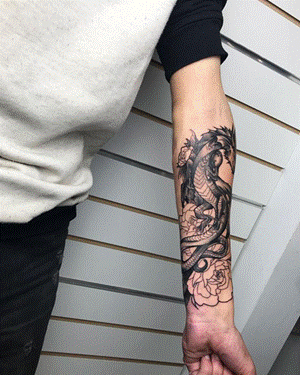
The snake and dagger is a long-standing tattoo motif, and the neo-traditional take on it updates the classic bold-line style with richer shading and slightly more realistic proportions, without losing the graphic punch of the original.
The dagger typically runs lengthwise along the forearm, with the snake coiling around the blade and handle, its head raised near the top of the design. This layout naturally follows the arm’s shape from wrist to elbow.
Neo-traditional style calls for confident black outlines combined with selective color, often deep reds and greens for the snake’s scales, set against black-and-grey shading for the blade and hilt to keep the metal looking convincing.
Because the composition is fairly self-contained, it works well as a standalone half sleeve, but it can also be extended by adding smaller motifs, such as roses or banners, above or below the main image to build toward a full forearm sleeve tattoo.
This concept tends to age well due to its bold linework, which holds ink better over the years compared to finer, more delicate line styles.
13. Phoenix Rising Fire Sleeve
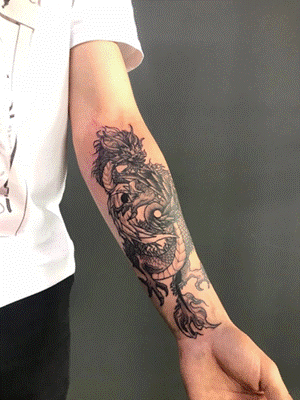
A phoenix rising from flames is a natural fit for a forearm sleeve tattoo, both symbolically and visually. The bird’s long tail feathers and upward motion give the artist a clear directional flow to work with along the arm.
The composition usually places the phoenix’s body and head near the elbow, with wings spread wide across the upper forearm and long feathers trailing down toward the wrist, where flames and embers can taper off naturally.
This design can be executed in full black-and-grey realism for a more restrained look, or with selective color accents in orange and red worked into the flames and feather tips for added visual intensity.
Smoke and drifting embers make useful filler elements between the main feathers, helping the piece feel continuous rather than having isolated sections of detail surrounded by empty skin.
Given the amount of feather and flame detail involved, this concept is best suited to a full forearm sleeve tattoo rather than a smaller placement, since the phoenix needs room to stretch its wings convincingly.
How to Choose the Right Forearm Sleeve Tattoo
Choosing a forearm sleeve tattoo starts with identifying what kind of statement feels right, whether that’s a personal story, a favorite animal, or simply a style that looks strong on its own.
It also helps to think about long-term commitment. A forearm sleeve is highly visible in everyday life, so it’s worth considering how a chosen design fits with work environments or personal preferences around visibility.
Looking through an artist’s portfolio before booking is one of the most reliable ways to judge fit. An artist skilled in black-and-grey realism may not be the strongest choice for a fine-line or geometric sleeve, and vice versa.
Best Tattoo Styles for Men’s Forearm Sleeves
Black-and-grey realism remains one of the most requested tattoo sleeve ideas for men, particularly for portraits, animals, and religious imagery, since it ages well and reads clearly at a distance.
Japanese-inspired work, neo-traditional pieces, and geometric or blackwork designs each bring a distinct visual language, giving men plenty of room to match a style to their personal taste rather than defaulting to one look.
Fine-line and minimalist styles have also grown in popularity for men who want a forearm sleeve tattoo that feels understated rather than dominating the whole arm.
How to Plan a Forearm Sleeve From Wrist to Elbow
Planning a full forearm sleeve tattoo usually starts by deciding on a focal point, often placed near the elbow or the mid-forearm where there’s the most surface area to work with.
From there, the design should be mapped out so smaller supporting elements taper naturally toward the wrist, rather than being added session by session without an overall plan.
Working with one artist from start to finish, or at least sharing detailed reference photos between sessions, helps keep linework, shading, and scale consistent across the entire sleeve.
Forearm Sleeve Tattoo Size and Placement
A half sleeve forearm tattoo typically covers either the upper or lower half of the forearm, while a full forearm sleeve tattoo extends from wrist to elbow, sometimes continuing up to the shoulder for a full arm piece.
Placement decisions often come down to visibility preferences. The outer forearm is more publicly visible, while the inner forearm offers a slightly more private canvas for personal or sentimental imagery.
Coverage should also factor in the arm’s natural movement, since designs that cross joints like the elbow can distort more noticeably when the arm bends compared to flatter sections of skin.
Black-and-Grey vs. Color Forearm Sleeves
A black-and-grey forearm tattoo tends to age more gracefully than heavily colored work, since black ink holds its saturation longer than most pigments, particularly under regular sun exposure.
Color sleeves, on the other hand, can bring extra vibrancy to themes like phoenixes, florals, or Japanese-inspired sleeves, especially when used selectively rather than across the entire design.
Many men choose a middle ground: a realistic forearm tattoo done primarily in black-and-grey, with small color accents added only where they carry the most visual impact.
How to Make Different Tattoo Elements Work as One Sleeve
The key to a cohesive sleeve tattoo lies in connective elements, such as smoke, foliage, water, or shading, that bridge the gaps between larger focal images rather than leaving them isolated.
Consistent line weight and shading style across all sections also matters. Mixing sharply different techniques within one sleeve can make it look like separate tattoos placed side by side rather than one unified piece.
Planning the overall composition in advance, even if the sleeve is completed over multiple sessions, gives the best chance of a forearm sleeve that reads as a single design from wrist to elbow.
How Long Does a Forearm Sleeve Tattoo Take?
The time required depends heavily on the style and level of detail. A simple geometric or fine-line half sleeve might be completed in two to three sessions, while a detailed black-and-grey realistic full sleeve can take five or more.
Larger, more intricate pieces like Japanese-inspired dragon sleeves or memento mori compositions often require multiple sittings spaced several weeks apart to allow the skin to heal between sessions.
Forearm Sleeve Tattoo Aftercare
Proper aftercare directly affects how a forearm sleeve tattoo heals and how well it holds detail over time. Keeping the area clean and following the artist’s specific aftercare instructions is the first priority.
Moisturizing regularly once the initial healing period passes helps prevent the skin from drying out, which can otherwise affect how sharp fine linework or shading looks once fully healed.
Sun protection matters more for forearm tattoos than for placements that stay covered, since the forearm is frequently exposed and UV exposure can fade ink faster over the years.
Frequently Asked Questions About Forearm Sleeve Tattoos
Is a forearm sleeve tattoo painful?
Pain levels vary by individual, but the forearm is generally considered more tolerable than areas like the ribs or inner elbow, since there’s more muscle and less bone close to the surface.
How much does a full forearm sleeve tattoo cost?
Cost depends on the artist’s rate, session length, and level of detail, so it’s best to request a quote directly from a chosen artist after discussing the specific design.
Can a half sleeve be extended into a full sleeve later?
Yes, many men start with a half sleeve forearm tattoo and extend it later, though planning ahead with the same artist makes it easier to keep the design visually consistent.
What style ages best on the forearm?
Bold black linework and black-and-grey realism tend to hold their detail longer than fine, delicate lines or heavily saturated color work, particularly with consistent sun protection.
Should the design be symmetrical on both arms?
That’s entirely a personal choice. Some men prefer matching sleeves on both arms, while others treat each arm as a separate canvas with its own theme.
Conclusion
A forearm sleeve tattoo offers one of the most versatile canvases available to men, whether the goal is a realistic lion portrait, a Japanese dragon, geometric patterns, or a darker gothic composition.
The strongest sleeves share a few common traits: a clear focal point, a style suited to the artist’s strengths, and enough connective detail to make the whole piece feel like one design rather than several unrelated tattoos.
Taking time to research styles, review portfolios, and plan the full sleeve before the first session tends to produce results that hold up visually for years, both in how the design looks and how well it ages.