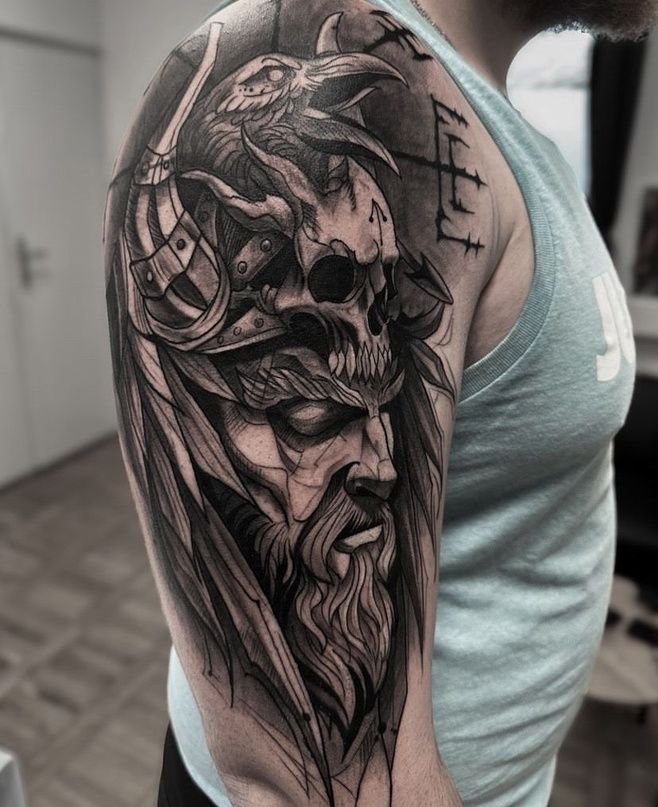
The upper leg has rapidly evolved into one of the most strategic canvas choices for modern body art. Once an overlooked placement compared to the forearm or chest, the upper leg offers an expansive area that naturally suits massive, high-detail concepts. Men choosing this area gain significant advantages in terms of versatility, privacy, and visual impact.
A well-executed design on the quad or outer leg creates a balance of physical strength and artistic taste. Because the muscle group provides a broad, flat expanse, artists can work with intricate linework and deep shading without compressing the image. It also offers effortless concealment under daily trousers while allowing immediate exposure during warmer weather or workout sessions.
Finding the right concept requires understanding how artwork interacts with body contours and physical movement. Whether the goal is a single standalone piece or the foundation for an entire leg sleeve, selecting a subject that works with leg anatomy ensures the tattoo remains dynamic from every angle.
The following 11 thigh tattoo ideas for men showcase how different artistic styles, structural flows, and thematic concepts can be applied to the upper leg for maximum visual performance.
1. Realistic Lion Portra
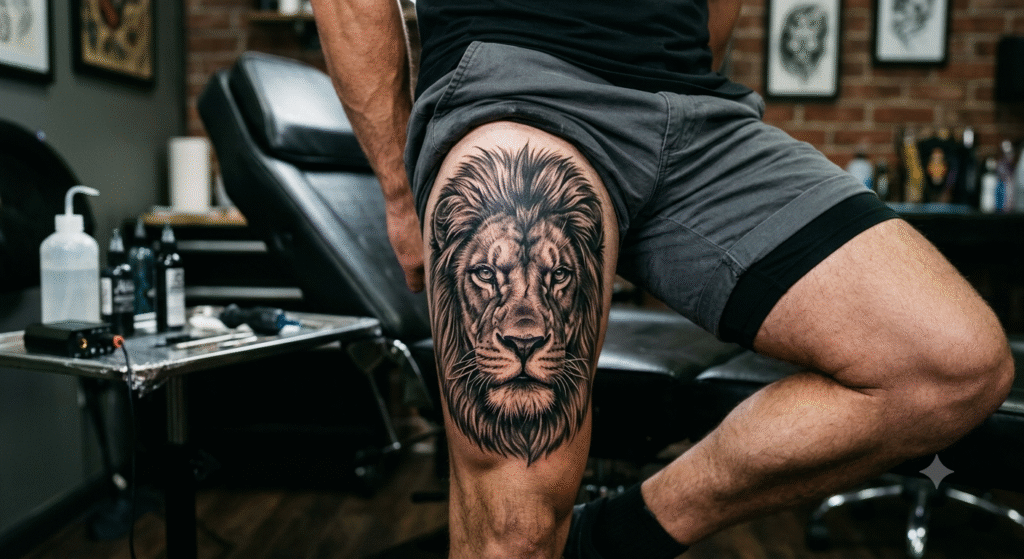
A lion portrait remains an enduring classic in modern ink culture, representing dominance, bravery, and personal sovereignty. When placed on the front quad, the naturally rounded form of a male lion’s face maps seamlessly across the vast muscle mass, creating a powerful forward-facing focal point.
To maximize the visual impact on the leg, realistic animal portraits require strong contrast and careful attention to directional fur texture. The broad surface permits micro-detailing around the eyes, nose, and mane, giving the animal a life-like presence that holds its integrity as the leg moves.
Choosing a full-frontal view allows the central axis of the lion’s face to align with the center of the thigh. Alternatively, a profile view sweeping outward toward the lateral quad adds dynamic motion to the leg structure. This design seamlessly connects with upper hip pieces or lower knee concepts down the road.
This concept appeals strongly to men seeking traditional symbols of strength executed with high technical refinement. Working with a specialist skilled in realistic tattoos ensures soft shading gradients that soften skin transitions without losing hard edge details.
2. Japanese Dragon (Ryu)
Source: justtscott / Getty Images
Traditional Japanese Irezumi art utilizes bodily movement better than almost any other tattooing style. The Japanese dragon, or Ryu, features a serpentine form that organically wraps around the cylindrical contour of the human leg, transforming the thigh into a three-dimensional display of classic mythology.
The flowing body of the dragon can originate at the hip, winding around the outer leg and terminating just above the kneecap. The inclusion of background elements like wind bars, swirling clouds, or crashing waves serves to frame the muscle structure, making the leg appear larger and more athletic.
Key structural elements of a traditional Japanese leg piece include high-contrast dragon scales with dramatic line weights, secondary floral accents, and deep background shading (gakubori). Color choices range from dramatic black-and-grey with selective red accents to full-spectrum vibrant hues like deep greens, gold, and blues.
Due to its continuous wrapping structure, this design is an exceptional starting point for anyone planning a comprehensive lower-body piece. It transitions effortlessly down into calf coverage or upward onto the ribs for an uninterrupted traditional motif.
3. Geometric Mandalas and Patterns
Source: MediaNews Group/Orange County Register via Getty Images / MediaNews Group via Getty Images
Geometric patterns and sacred geometry offer a modern, highly structured aesthetic that highlights physical conditioning. Mandalas, tessellation patterns, and sacred geometry rely on precise symmetry and mathematical line weight to create optical depth across the leg.
A central mandala positioned directly over the main quad serves as an anchor, while tessellating geometric shapes flow outward to wrap the inner and outer leg. This layout creates an architectural quality that complements the natural separation lines between the quadriceps muscles.
Executing dotwork shading within geometric patterns produces a soft, gradient contrast that contrasts nicely with crisp outer lines. Precision is critical here, as any line distortion becomes immediately apparent across large muscle surfaces.
This style fits men who value clean symmetry, structural order, and abstract symbolism. It pairs exceptionally well with upper body geometric work, such as structured arm tattoos, to maintain a cohesive design language across the entire body.
4. Greek Gods and Mythology
Source: Abdullah Durmaz / Getty Images
Classical statues of Greek deities like Zeus, Poseidon, or Apollo bring timeless artistic weight to body art. The upper leg offers the necessary height to display full-stature god statues or detailed facial portraits complete with flowing marble-textured hair and architectural ruins.
Mythological themes allow for narrative storytelling across the skin. A portrait of Poseidon surrounded by tempestuous ocean waves can flow down the outer thigh, utilizing smooth grey wash shading to mimic chiseled marble stone.
Because human quads possess natural volume, sculpting god portraits onto this area adds a realistic three-dimensional depth. Strong highlights and deep black shadows are required to give the stone texture a tangible weight.
This choice suits men who appreciate classical art, ancient history, or themes of raw power and divine control. Connecting a mythological thigh piece upward toward chest or rib panels creates an epic narrative arc across the torso and leg.
5. Skull and Botanical Blackwork

Source: Reddit
Combines dark imagery with organic botanical elements creates a striking balance of mortality and growth. A central human or animal skull enveloped by dark foliage, vines, or roses makes full use of the broad quad space while offering rich contrast through heavy black ink application.
The structure of a skull piece benefits from placement directly on the front upper leg, where the cheekbones and eye sockets can be scaled up dramatically. Leaves and trailing vines can then be used by the artist to wrap around toward the inner thigh, softening the edges of the main image.
Blackwork relies on saturated solid blacks alongside crisp negative space to create visual hierarchy. The depth achieved by packing dense black ink ensures the piece remains sharp and highly legible from a distance.
Men who lean toward edgy, gothic, or dark illustrative aesthetics frequently choose blackwork skulls. The bold contrast also makes this style an ideal choice for covering older, unwanted leg ink.
6. Norse Compass (Vegvisir) and Viking Lore
Source: ArtVector / Getty Images
Norse mythology provides rich iconographic material ranging from runic symbols and the Vegvísir (the Runic Compass) to depictions of Odin, wolves, and battle-worn axes. The rectangular shape of Viking axes or tall runic pillars matches the long vertical orientation of the human femur.
Placing the Vegvísir compass in the center of the thigh surrounded by intricate Norse knotwork creates a grounded, shield-like appearance. The surrounding knotwork can be customized to weave across the quad, accentuating muscle movement during physical activity.
Texturing the linework to resemble carved stone or aged wood adds an authentic historical atmosphere to the composition. Heavy whip-shading and coarse stippling work best to achieve this weathered effect.
This theme resonates with individuals drawn to concepts of guidance, exploration, and resilience. For those looking to expand their collection, Norse themes easily flow into full-length leg tattoos covering the calf and ankle.
7. Biomechanical and Cybernetic

Source: Inkden Tattoo Studio
Biomechanical designs create the optical illusion that the skin is tearing away to reveal intricate mechanical components underneath. Hydraulic pistons, carbon fiber weaves, gears, and glowing energy wires can be mapped directly over the underlying muscle groups.
By placing mechanical shock absorbers along the vastus lateralis (outer quad), the artwork visually mimics the functional anatomy of the human leg. As the leg flexes and bends, the static tattoo gives the impression of dynamic machinery in motion.
Achieving realism in biomechanical art requires advanced light and shadow manipulation:
- Torn Skin Edges: Drop shadows created beneath the “ripped” skin layer produce 3D depth.
- Metallic Highlights: Opaque white ink accents give steel components a reflective sheen.
- Depth Layers: Deep black backgrounds push internal gears downward into the muscle cavity.
This style caters to fans of science fiction, modern industrial design, and futuristic concepts. Because of its complex layering, biomechanical work requires an experienced specialist in black and grey tattoos or full-color realism.
8. Traditional American Dagger and Serpent
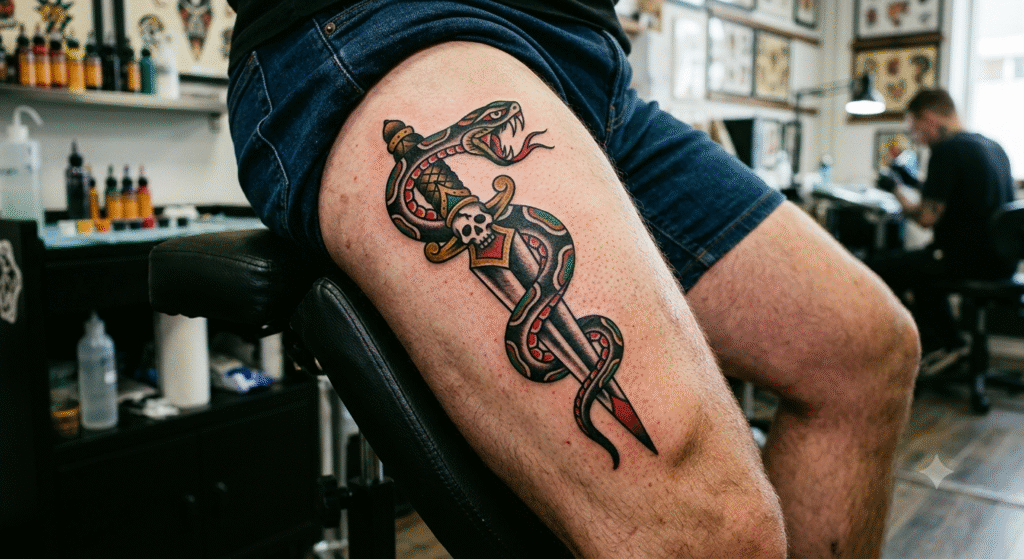
American Traditional tattooing is defined by bold black outlines, a restricted color palette, and iconic symbolism. A classic motif like a dagger piercing through a coiled serpent or a panther fits the upper leg perfectly due to its strong vertical orientation.
The straight line of the dagger blade establishes a bold central axis down the front of the thigh, while the winding body of the serpent adds width and organic shape across the quad. The heavy black borders ensure the image remains bold and readable over decades.
Traditional color palettes rely on saturated primary tones:
- Deep Reds: Applied to serpent tongues, floral elements, or blood accents.
- Golden Yellows: Used for dagger hilts, banners, or reptile underbellies.
- Rich Greens and Blues: Added to create classic contrast against solid black shading.
This design suits men who admire heritage tattoo culture and timeless flash art. It offers an excellent standalone option or can serve as the centerpiece within a broader collection of traditional patchwork pieces on the leg.
9. Phoenix Rising
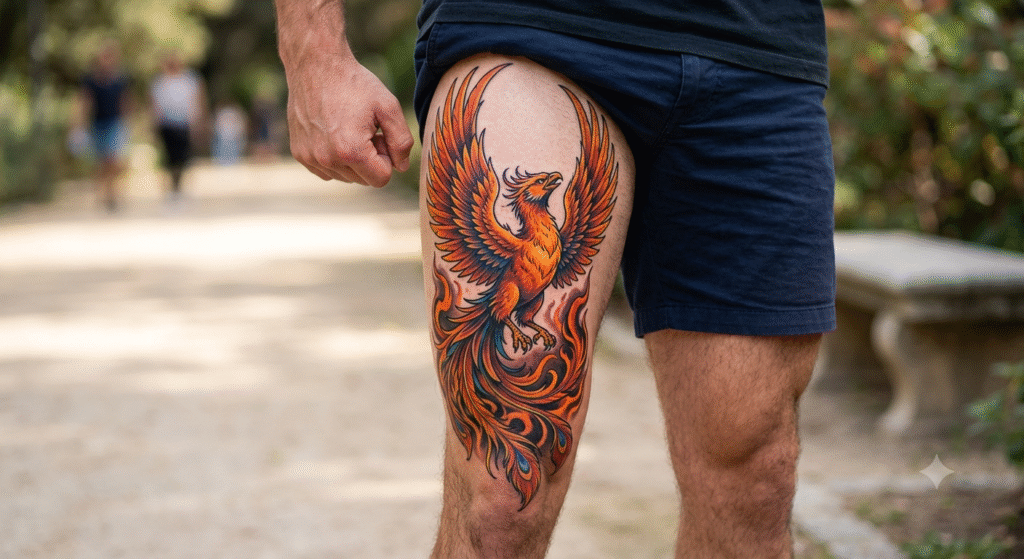
The mythic phoenix symbolizes rebirth, transformation, and conquering adversity. Because the bird is depicted with soaring wings and long, trailing tail feathers, its silhouette adapts seamlessly to the vertical and curved dimensions of the upper leg.
Positioning the head and body of the phoenix on the mid-quad allows the primary wing span to sweep outward toward the hip, while the feathered tail trails down toward the knee. This layout emphasizes the natural sweep of the leg muscles.
Color application brings a phoenix piece to life through warm gradients of crimson, burnt orange, and gold set against cool background shadows. Alternatively, high-contrast black and grey rendering creates a dramatic, charcoal-drawn aesthetic.
This motif appeals to men who want to honor a major personal transformation or significant life milestone. It connects cleanly with upper body artwork like sleeve tattoos or chest pieces via connecting flame or feather motifs.
10. Polynesian Tribal (Tatau)
Source: Marina Piskunova / Getty Images
Polynesian, Marquesan, and Samoan Tatau carry rich cultural histories where specific geometric motifs denote genealogy, personal status, and warrior strength. The upper leg provides a massive, traditional canvas for these intricate blackwork patterns.
Unlike standalone imagery, Polynesian tribal art wraps entirely around the thigh, framing the leg with dense black bands and rhythmic repeating symbols. Speartips, shark teeth (niho mano), and ocean waves are arranged systematically to accentuate physical leg structure.
Custom fit is essential for Polynesian leg work:
- Muscle Flow: Patterns curve along muscle divisions rather than cutting straight across.
- Solid Saturation: Deep, evenly packed black ink creates necessary graphic punch.
- Negative Space Bands: Clean un-inked lines break up dense sections to keep the leg looking defined.
This style fits men seeking bold, ancient graphic art with deep personal or cultural meaning. It serves as an impressive standalone thigh band or can extend seamlessly into a full lower-body pe’a inspired design.
11. Abstract Line Art and Micro-Realist
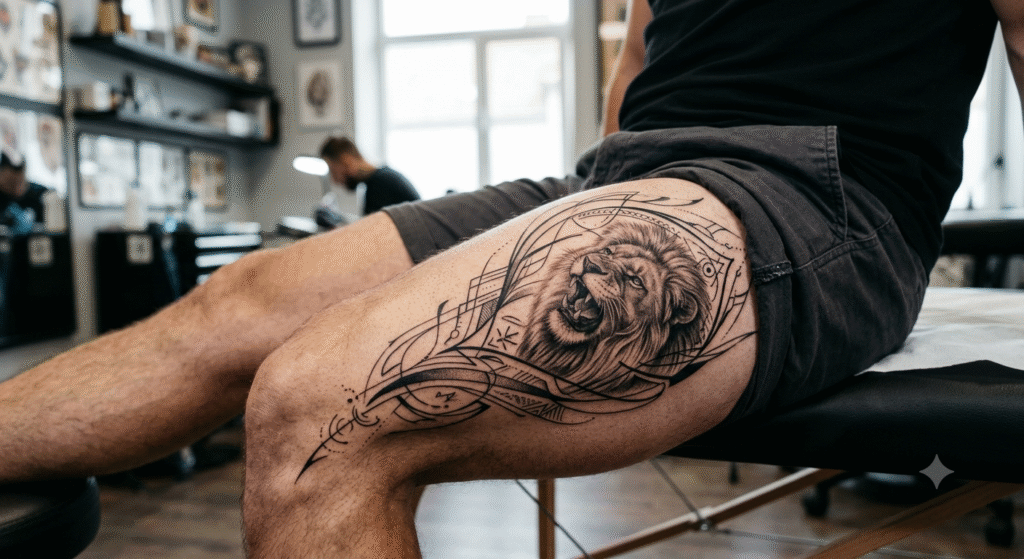
For a contemporary, understated aesthetic, abstract fine-line art combined with micro-realism offers an intellectual alternative to heavy blackwork. This style blends single-line portraiture, architectural drafting lines, and subtle botanical elements.
The lightweight nature of fine-line work creates an open composition on the leg. Rather than covering the quad entirely in dark ink, the design utilizes open skin as an active canvas element, placing delicate geometric lines or miniature realistic portraits precisely along muscle contours.
Maintaining fine-line integrity requires precise technique and proper needle selection. Delicate linework requires soft gray shading to provide structure without overwhelming the subtle line weights.
This approach suits men who prefer subtle, artistic, and modern minimalist design. Fine-line pieces are also easily integrated alongside existing body art, such as minimalist forearm tattoos.
How to Choose the Right Thigh Tattoo
Selecting the ideal design for the upper leg comes down to evaluating three main factors: personal style, physical shape, and long-term plans for body art. Because the thigh offers significant canvas space, smaller designs can sometimes look lost if they are not framed or placed correctly.
Consider whether you prefer a forward-facing design on the central quad, a sweeping outer-leg piece, or a design that fully wraps the leg. Matching your chosen subject to the natural muscle contours ensures that your ink looks well-proportioned whether you are standing, sitting, or moving.
Best Tattoo Styles for Men’s Thighs
Certain artistic styles perform exceptionally well on the upper leg due to its size and shape:
- Realism and Portraits: The smooth expanse of the quad allows for fine detailing in human faces, animal portraits, and statues.
- Japanese Irezumi: Continuous wrapping elements like dragons, snakes, and water waves naturally complement the leg’s shape.
- Blackwork and Geometric: Bold line work and dotwork shading create high-contrast designs that highlight leg conditioning.
- Traditional / Neo-Traditional: Strong black outlines and saturated colors hold up extremely well on large skin surfaces over time.
Upper Thigh vs Outer Thigh Placement
Placement significantly alters how a tattoo is viewed and how much privacy it offers:
| Placement Area | Visual Characteristics | Privacy Level | Ideal Design Types |
|---|---|---|---|
| Upper Quad (Front) | High visibility in shorts; strong forward impact | Medium (Covered by trousers) | Portraits, Mandalas, Skulls, Animal Heads |
| Outer Thigh (Lateral) | Long vertical canvas; elongates the leg | High (Concealed easily) | Daggers, Dragons, Biomechanical, Statues |
| Full Wrap (Sleeve) | 360-degree coverage; massive visual impact | Dependent on length | Japanese Irezumi, Polynesian Tribal, Geometric |
How Large Should a Thigh Tattoo Be?
As a general rule, thigh tattoos look best when scaled generously. A small 3-inch tattoo placed in the middle of a large quad often looks unbalanced. Aiming for a piece that fills at least 50% to 70% of the upper leg area creates a much more intentional, polished appearance.
If you prefer smaller individual designs, consider arranging them in a patchwork layout framed by background shading or complementary filler elements.
Black-and-Grey vs Color Thigh Tattoos
Choosing between black-and-grey and color depends largely on your existing tattoos and personal maintenance preferences:
- Black-and-Grey: Offers a classic, timeless aesthetic with low maintenance needs. It relies on smooth grey washes and high-contrast blacks that age gracefully over time.
- Full Color: Creates vibrant visual pop, especially in styles like Traditional, Japanese, or Illustrative. Color pieces require careful sun protection (SPF 50) to prevent premature fading on exposed legs during summer months.
How Painful Are Thigh Tattoos?
Thigh tattoo pain varies significantly across different zones of the leg:
- Outer Thigh (Lateral Quad): Generally low to moderate pain. The thick muscle and dense skin make this one of the most comfortable placement areas on the body.
- Front Quad: Moderate pain. The center quad is quite manageable, though sensitivity increases as the needle approaches the kneecap.
- Inner Thigh: High pain. The skin here is thin, delicate, and close to nerve pathways, making it one of the most sensitive spots on the lower body.
How to Plan a Future Leg Sleeve
If you plan to eventually collect a full leg sleeve, starting on the thigh provides a solid anchor point. Ensure your artist designs clean, open borders around the bottom and sides of your thigh piece.
Leaving soft, gradient edges or un-inked background spaces allows future calf and knee tattoos to merge naturally into the upper leg artwork without harsh break lines.
Thigh Tattoo Aftercare Tips
Proper aftercare ensures your thigh ink heals clearly without color loss or scarring:
- Wear Loose Clothing: Avoid tight jeans, compression pants, or fitted gym shorts for the first 10-14 days to prevent friction against healing skin.
- Keep It Clean: Wash gentle with unscented liquid soap twice daily and pat dry with clean paper towels.
- Moisturize Sparingly: Apply a thin layer of fragrance-free lotion or specialized tattoo balm; avoid over-saturating the fresh tattoo.
- Avoid Submersion: Stay out of swimming pools, hot tubs, and baths until all scabbing and peeling are fully resolved.
Frequently Asked Questions About Thigh Tattoos for Men
Are thigh tattoos painful for men?
Outer and front thigh tattoos are generally manageable with low to moderate pain levels. However, the inner thigh and areas close to the kneecap or groin carry significantly higher sensitivity.
What size works best for a thigh tattoo?
Medium to large designs work best on the upper leg. Mid-to-large pieces that cover a substantial portion of the quad look well-proportioned and allow for crisp detail that lasts over time.
Which tattoo styles look best on muscular thighs?
Styles with continuous flow or large focal points—such as Japanese Irezumi, Black and Grey Realism, Geometric Mandalas, and Polynesian Tribal—look outstanding on well-developed quadriceps.
Is the upper thigh a good placement for a first tattoo?
Yes, the outer upper thigh is considered an ideal spot for a first tattoo because of its low pain sensitivity, large canvas space, and easy concealment under everyday clothing.
Do thigh tattoos stretch or change with muscle growth?
Unless you experience rapid, extreme physical changes, typical muscle growth from weight training or routine fitness will not visibly stretch or distort a well-placed thigh tattoo.
How long does a large thigh tattoo take to heal?
Surface healing generally takes 2 to 3 weeks, while deep tissue healing resolves in about 4 to 6 weeks. Following standard aftercare routines speeds up the recovery process significantly.
Conclusion
The upper leg represents one of the most versatile and impactful body art placements available to men today. Offering a vast canvas that balances effortless privacy with striking visibility, the thigh easily accommodates bold concepts ranging from classical mythology and realistic portraits to dynamic biomechanical structures and timeless Japanese motifs.
Choosing the right design involves matching your chosen aesthetic to your natural leg anatomy, selecting an appropriate scale, and working with an experienced artist who understands how muscle movement interacts with body art. Whether you choose a single standalone statement piece or start building toward a full leg sleeve, a well-planned thigh tattoo delivers an enduring balance of physical strength and artistic style.