The back of the thigh offers a unique combination of canvas space, privacy, and artistic impact. It remains hidden under trousers or long skirts in formal or professional environments, yet commands immediate attention when revealed in swimwear, shorts, or split skirts.
Getting inked on the posterior upper leg gives body art enthusiasts the freedom to explore large-scale compositions, delicate wrap-around bands, or deeply personal motifs without worrying about daily workplace visibility. Choosing a design for this area requires an understanding of muscle movement, skin elasticity, and how line work sits when standing versus sitting.
Whether someone is planning their first major piece or adding to a full leg sleeve, these thirteen carefully curated ideas demonstrate the versatility of the upper back leg placement.
Why Choose a Back of Thigh Tattoo?
The upper back leg provides one of the largest continuous flat surfaces on the human body, ideal for detailed artwork. Unlike the lower leg or forearm, this area changes less dramatically with minor body fluctuations, offering long-term stability for precise line work.
Privacy remains a key advantage for collectors who prefer discreet body art. A back of thigh tattoo stays entirely concealed beneath standard clothing, making it an excellent choice for individuals working in conservative corporate settings or traditional industries.
The movement of the hamstrings and gluteal fold creates a dynamic canvas. When walking, running, or bending, the tattoo shifts with natural movement, giving organic shapes like snakes, vines, and dragons a living appearance
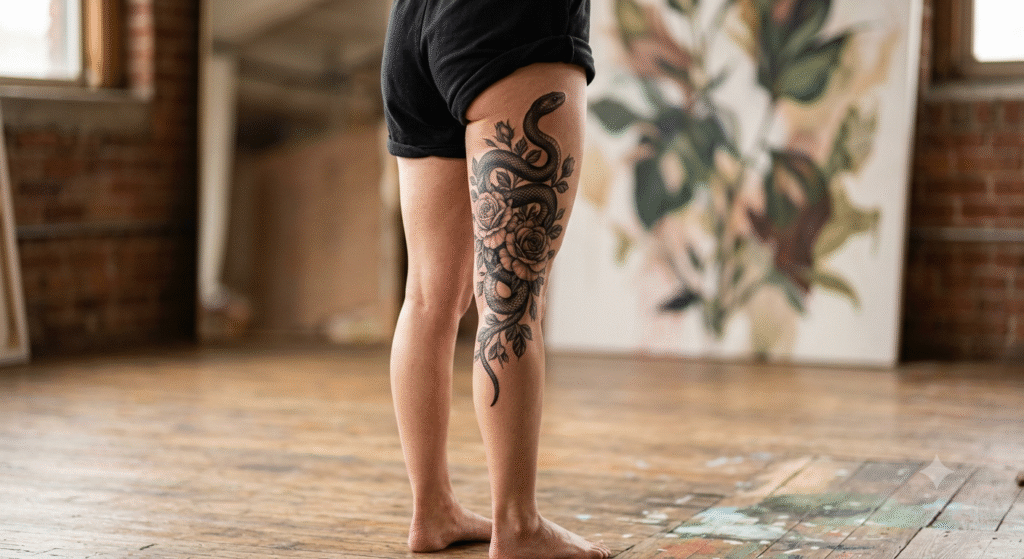
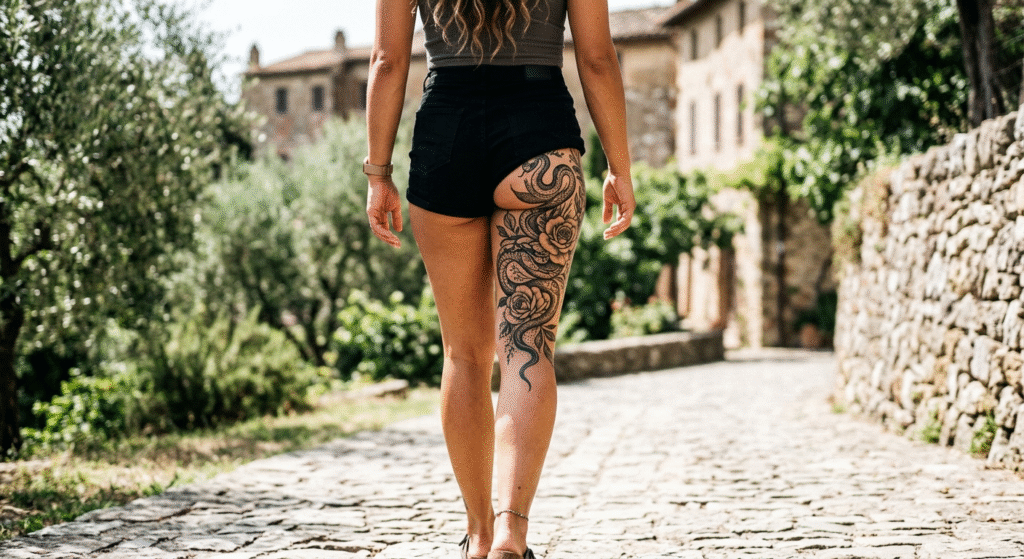
1. Coiling Snake and Botanical Rose
The coiling snake combined with botanical roses creates an intriguing visual balance between structure and fluidity. The natural curves of the serpent wrap around the hamstring muscle, accentuating the contours of the upper leg.
Design Details
This composition pairs a detailed, scales-heavy serpent with soft, full-bloomed roses and realistic foliage. Deep black shading on the snake provides strong contrast against the delicate stippling on the flower petals.
Placement and Style
Positioned central to the hamstring, the snake’s head often rests near the gluteal crease while the tail wraps gracefully toward the outer leg. The piece works exceptionally well in illustrative blackwork or dotwork styles.
Size and Overall Visual Impact
A vertical length of 8 to 12 inches allows sufficient space for fine scale details and floral shading. The finished piece looks sophisticated and edgy, combining themes of transformation and beauty.
2. Japanese Irezumi Dragon
A Japanese Irezumi dragon brings timeless mythology and powerful motion to the back of the leg. Traditional Japanese motifs adapt seamlessly to large bodily contours, utilizing wind bars and clouds to frame the central creature.

Source: Ink Happened
Design Details
The design features sharp claws, swirling tendrils, dynamic scales, and traditional elemental accents like waves or cherry blossoms. Deep black inks form heavy contrast alongside bold red or emerald green color splashes.
Placement and Style
Starting just below the hip fold, the dragon’s body winds vertically down the hamstring toward the popliteal space behind the knee. Authentic Japanese Traditional or Neo-Japanese styles give the tattoo its signature power.
Size and Overall Visual Impact
This design thrives as a large-scale project, often spanning 12 to 16 inches. It turns the entire posterior thigh into a dramatic, museum-grade body art showcase.
3. Delicate Lace Garter and Floral Band
The lace garter tattoo mimics delicate lingerie, wrapping horizontally around the upper leg. It provides a timeless, sensual aesthetic that feels both ornamental and highly personal.

Source: Facebook
Design Details
Intricate lace patterns intertwine with small roses, peonies, or wild berries. Fine-line detailing creates the illusion of translucent fabric draped soft against the skin, punctuated by subtle jewels or hanging beads.
Placement and Style
Encircling the upper third of the thigh roughly 2 to 4 inches below the buttocks crease, this design relies on precise symmetry. Fine-line black and grey or ornamental dotwork styles suit this concept best.
Size and Overall Visual Impact
Measuring 3 to 5 inches in width and wrapping entirely around the leg, it stays hidden beneath short skirts while offering an elegant, jeweled appearance when exposed.
4. Ornamental Mandala with Draped Jewelry
Mandala tattoos symbolize balance, unity, and eternity. Placing a mandala on the back of the leg allows symmetry to center naturally along the hamstring axis.
Source: Facebook
Design Details
Geometric petals expand outward from a central focal point, surrounded by hanging chandelier beads, teardrop gems, and delicate filigree linework. Smooth whip-shading adds depth to overlapping layers.
Placement and Style
The main mandala hub rests right beneath the gluteal fold, with decorative chains extending downward. Geometric, ornamental, or sacred geometry styles emphasize the precision of the pattern.
Size and Overall Visual Impact
Typically spanning 6 to 9 inches in height and width, this design offers a striking, bohemian elegance that harmonizes with the body’s natural symmetry.
5. Fine Line Script and Meaningful Quotes
Typography offers a direct method for expressing personal philosophies, literary excerpts, or memorable dates. The linear space on the posterior thigh serves as a discreet canvas for horizontal or vertical text

Source: facebook.com
Design Details
Clean cursive lettering, elegant calligraphic script, or modern typewriter fonts keep the message legible and refined. Micro-script options offer ultimate subtlety for those seeking minimalist body art.
Placement and Style
Horizontal quotes fit neatly directly under the gluteal fold, while vertical text can trace straight down the back of the hamstring muscle. Fine line or single-needle tattooing ensures crisp character edges.
Size and Overall Visual Impact
Ranging from 4 to 8 inches horizontally or up to 10 inches vertically, script pieces maintain a clean, literary quality that remains deeply intimate.
For more inspiration on text-based designs and delicate placement options, explore our complete guide to meaningful tattoo ideas.
6. Classical Marble Sculpture Portrait
Classical Renaissance or Greco-Roman sculpture portraits bring high-art realism directly to skin. The natural curvature of the thigh provides a three-dimensional depth that suits sculpted stone faces.
Source: Facebook
Design Details
The portrait showcases carved marble textures, realistic cracks, draped stone fabrics, and expressive facial features. Dramatic lighting effects in the design emulate museum spotlights using smooth black and grey shading.
Placement and Style
Centered squarely on the fleshy portion of the hamstring muscle to minimize distortion during leg movement. Micro-realism or realistic black and grey styles deliver the required stone-like texture.
Size and Overall Visual Impact
A medium-to-large footprint of 7 to 10 inches guarantees that intricate facial details, smooth shading gradients, and marble highlight work remain sharp over time.
7. Celestial Moon Phases and Stardust
Celestial imagery represents passage, rhythm, and mystery. Depicting the lunar cycle along the back leg creates a graceful vertical rhythm that elongates the leg visuall
Source: Cuded | Art and Design |
Design Details
This layout tracks the full lunar progression from thin waxing crescents to full glowing moons and fading waning slivers. Fine starbursts, constellation maps, and subtle cosmic dust tie the individual moons together.
Placement and Style
Arranged vertically down the center line of the back thigh, following the natural seam of the hamstring. Illustrative blackwork, dotwork, or delicate watercolor styles elevate the cosmic theme.
Size and Overall Visual Impact
Measuring 8 to 12 inches vertically, this layout creates an appealing lengthening effect on the leg while delivering a mystical aesthetic.
8. Abstract Geometric and Linework Art
Abstract geometric designs offer a modern, architectural alternative to traditional imagery. They utilize line weight variation, overlapping polygons, and optical illusions to complement human anatomy.

Source: 1MM Tattoo Studio
Design Details
Intersecting vector lines, solid black fill blocks, stippled gradient circles, and parallel hatching patterns form a non-figurative composition tailored specifically to the client’s muscle structure.
Placement and Style
Positions vary from centered arrangements to asymmetrical wraps extending from the outer thigh toward the back center. Modern geometric, minimalist linework, or contemporary abstract styles work best.
Size and Overall Visual Impact
A flexible size of 6 to 11 inches allows these designs to adapt seamlessly to small personal statements or prominent contemporary leg art.
9. Mythological Phoenix Rising
The mythological phoenix symbolizes rebirth, resilience, and personal renewal. Its fiery plumage and trailing tail feathers make it an exceptional subject for dynamic, flowing leg tattoos.
Source: Our Mindful Life
Design Details
The design depicts the mythical bird spreading its wings, with long, ornate tail plumes cascading downward like flames. Vibrant oranges, deep reds, and bright yellows create striking contrast against black linework.
Placement and Style
The phoenix body rests on the main hamstring canvas, with its tail feathers extending downward toward the back of the knee. Neo-Traditional, Illustrative, or Japanese styles enhance the bird’s dramatic presence.
Size and Overall Visual Impact
Best executed across 10 to 14 inches, this bold piece turns the back leg into an uplifting emblem of transformation.
If you are interested in exploring other animal and mythological symbolism for your next tattoo project, check out our gallery of animal tattoo meanings.
10. Neo-Traditional Animal Sentinel
Neo-traditional animal portraits combine the bold line structure of classic tattooing with modern color palettes and decorative framing. Wolves, stags, owls, or panthers make strong choices for the posterior thigh.

Source: Facebook
Design Details
The animal head sits centered within an ornate frame, surrounded by jewel tones, autumn leaves, or geometric shapes. Bold outer borders enclose smooth interior gradients and expressive eyes.
Placement and Style
Placed squarely in the middle of the back thigh, providing balanced visual weight from both behind and side angles. Neo-Traditional tattooing remains the essential style here.
Size and Overall Visual Impact
Covering an 8 by 6 inch area, this design offers high readability, vibrant color retention, and timeless graphic appeal.
11. Dark Surrealism Frame
Dark surrealism fuses dreamlike logic with dark, gothic imagery. It appeals to collectors who appreciate mysterious, narrative-driven art pieces that evoke thought and conversation.

Source: Tattoofilter
Design Details
Elements like anatomical hearts blooming with fungi, melting clocks, floating eyes, or veiled figures combine seamlessly. Deep black fills contrast sharp high-light details to create eerie atmospheric depth.
Placement and Style
Centered on the posterior leg to give complex storytelling elements an uninterrupted canvas. Dark surrealism, black and grey realism, or illustrative darkwork are ideal choices.
Size and Overall Visual Impact
Ranging from 8 to 12 inches, this style demands a larger canvas to maintain detail clarity, making the back thigh an ideal home.
12. Biomechanical Mechanical Core
Biomechanical tattoos simulate machinery, hydraulics, and structural steel functioning underneath human skin. This style plays directly on muscle mechanics during movement.

Source: Facebook
Design Details
Realistic torn skin effects reveal hyper-detailed pistons, shock absorbers, carbon fiber weave, and metallic tubing. Metallic silver highlights and deep shadow pockets give the illusion of genuine 3D depth.
Placement and Style
Aligned with the hamstring muscles and tendons to enhance the illusion that the leg is powered by internal machinery. Bio-mechanical or 3D realism styles are necessary here.
Size and Overall Visual Impact
Spanning 10 to 15 inches, this full-coverage option turns the back leg into an impressive sci-fi art installation.
13. Minimalist Fine Line Contour Art
For collectors who prefer understatement over density, minimalist fine-line art delivers maximum artistic thought with clean simplicity. Single-line continuous drawings fit this aesthetic perfectly.
Source: Devilz Tattoo
Design Details
Simple continuous line profiles, botanical stems, or delicate hand gestures created with ultra-thin needle groupings. The design uses negative space as a fundamental component of the composition.
Placement and Style
Offset toward the lower corner near the knee crease or tucked subtly under the glute fold. Fine-line, single-needle, or minimalist styles ensure delicate results.
Size and Overall Visual Impact
Compact sizes between 3 and 5 inches create a subtle, gallery-like piece that feels lightweight and effortlessly modern.
Placement Considerations for the Posterior Thigh
Placement on the back of the leg requires precise attention to body mechanics. The skin on the upper leg stretches significantly when sitting or bending forward, which can alter geometric symmetry if not accounted for during stenciling.
A skilled artist will stencil the design while the client is standing naturally in an upright position. They will then inspect the stencil while the client sits and walks to ensure the artwork holds its shape across all natural leg movements.
The gluteal fold at the top of the thigh acts as a natural frame for horizontal or semi-circular patterns like garters and mandalas. Lower down, near the back of the knee, the skin thins dramatically, which should influence design complexity toward the bottom edge.
Vertical flow works best for single-subject pieces like snakes, scripture, or celestial moons. Aligning the main axis of the design with the central line of the hamstring ensures the piece looks centered when viewed from behind.
Pain Scale: What to Expect
Pain levels on the back of the thigh range from moderate to high, depending on the exact area being inked. The middle section of the hamstring is generally manageable, registering around a 4 to 6 out of 10 on standard pain scales.
The upper region near the gluteal crease and inner thigh contains a higher concentration of nerve endings, bumping sensitivity up to a 7 out of 10. The skin here is soft and supple, requiring a light touch from the tattooer.
The lower region near the back of the knee (the popliteal fossa) is notoriously sensitive. Inking near this crease can trigger involuntary leg twitching due to nerve pathways, so artists often caution against extending heavy solid fills directly into the joint pit.
| Area of Posterior Thigh | Pain Level (1–10) | Sensitivity Description |
|---|---|---|
| Mid-Hamstring | 4–6 | Moderate fleshiness; steady dull ache |
| Upper Gluteal Fold | 6–7 | Sensitive skin; sharp stinging sensations |
| Inner Back Thigh | 7–8 | Soft thin skin; high nerve concentration |
| Popliteal Space (Knee Pit) | 8–9 | Very high sensitivity; involuntary twitch response |
Sizing and Proportion Guide
Choosing the correct size for a back of thigh tattoo determines how well the piece ages over time. Small designs placed in the middle of a large muscle group can look lost, while oversized pieces may wrap too far around the sides, losing visual impact from a rear perspective.
Medium-to-large pieces measuring between 7 and 12 inches generally suit the scale of the posterior thigh best. This size range allows enough room for intricate line work, smooth shading gradients, and breathing space around the edges.
Horizontal designs like lace garters or banner quotes should follow the natural circumference of the leg without pinching the silhouette. Vertical designs should taper slightly at the bottom to mirror the leg’s natural narrowing toward the knee joint.
Matching Tattoo Styles to Your Aesthetic
Different tattoo styles bring distinctly different moods to the upper back leg canvas:
- Black and Grey Realism: Ideal for portraits, classical statues, and dark surrealism. It offers smooth transitions and a timeless aesthetic.
- Fine Line and Dotwork: Perfect for lace garters, sacred geometry, and minimalist motifs. It produces a soft, elegant finish that ages gracefully.
- Neo-Traditional: Features bold outer lines and rich color palettes that withstand sunlight exposure and maintain legibility from a distance.
- Japanese Irezumi: Takes full advantage of the leg’s length, using traditional background fills to integrate seamlessly with larger leg projects.
Gender-Neutral and Versatile Inspiration
Back of thigh tattoos are entirely gender-neutral. While delicate lace garters are traditionally popular among women, bold geometric linework, mythological creatures, classical art, and biomechanical designs appeal equally across all demographics.
The key to a successful unisex design lies in line weight, scale, and thematic framing. Stronger line weights and darker fill blocks create a bold graphic statement, while lighter line weights and open negative space lean delicate and subtle.
Collaborating with a professional tattoo artist allows any motif—whether floral, animal, or abstract—to be customized to suit your personal aesthetic and anatomical structure.
Essential Aftercare for Back of Thigh Tattoos
Aftercare for the back of the thigh requires extra care due to daily sitting habits and clothing friction. The constant contact between sitting surfaces and healing skin makes proper maintenance vital during the first two weeks.
Avoid tight jeans, leggings, or rough fabrics that rub against the fresh tattoo. Loose-fitting cotton trousers, loose shorts, or skirts prevent friction-induced ink lift and reduce irritation.
When sitting for extended periods, try to shift weight forward or sit on a soft, clean cushion. Avoid prolonged sitting on hard wooden or metal chairs during the initial peeling phase to prevent scabs from pulling prematurely.
Wash the area twice daily with fragrance-free antibacterial soap, pat dry with a clean paper towel, and apply a thin layer of recommended tattoo ointment. Once light peeling begins, switch to a unscented lotion.
Never submerge the healing tattoo in baths, hot tubs, or swimming pools for at least three weeks. Keep the area shielded from direct sunlight during healing, and apply broad-spectrum sunscreen once the skin has fully recovered.
Frequently Asked Questions
How long does a back of thigh tattoo take to heal?
Surface skin healing usually takes 2 to 3 weeks, during which peeling and minor itching occur. Deeper dermal healing takes approximately 2 to 3 months, after which the ink settles completely into the skin.
Can I sit down normally after getting the back of my thigh tattooed?
You can sit down, but it may feel uncomfortable for the first few days. It is best to avoid sitting on hard surfaces for long periods and to wear loose cotton clothing to minimize friction and sweat buildup.
Do back of thigh tattoos fade quickly?
Because the back of the leg is frequently covered by clothing, it receives less direct sun exposure than arms or hands. Consequently, back of thigh tattoos tend to retain their vibrancy and color integrity exceptionally well over time.
Final Thoughts
A back of thigh tattoo is an empowered choice for collectors seeking a bold hidden statement. It blends secret personal expression with impressive visual impact, offering a generous canvas for diverse artistic styles.
Whether you prefer the delicate symmetry of an ornamental garter, the narrative depth of classical realism, or the energy of a Japanese dragon, taking time to plan placement and aftercare guarantees a stunning piece of body art that lasts a lifetime.
To discover more design ideas and expert placement advice for your next tattooing adventure, explore our extensive library of guides at Tattoo Dreams Today.