Commiting to a full leg sleeve tattoo is one of the most ambitious and rewarding decisions a tattoo collector can make. Unlike the arms, the lower body offers an expansive, dynamic canvas with distinct muscle groups, natural curves, and varying pain thresholds.
Whether planning a cohesive full leg tattoo that flows seamlessly from hip to ankle or building out individual concepts across the upper thigh tattoo zone down to the lower calf tattoo, selecting the right aesthetic is essential. The following 11 concept ideas break down artistic styles, strategic flow, shading nuances, and placement tips to help craft a show-stopping piece of body art.
For additional inspiration on planning large-scale artwork, explore curated delicate minimalist designs to bold statement pieces before booking a consultation.
tattoodreamstoday.com
1. Black and Grey Hyper-Realism

Source: Zen Tattoo Studio
Black and grey hyper-realism remains a timeless choice for anyone wanting a striking leg sleeve tattoo. This approach relies entirely on smooth tonal transitions, precise contrast, and white ink highlights rather than harsh outer linework.
Design & Elements
Portraits, realistic wildlife, classical sculptures, and architectural motifs work exceptionally well in this format. Placing large focal points—like a lion face or Greek statue portrait—on the prominent front portion of the upper thigh sets a powerful visual anchor.
Flow & Placement
The natural contours of the leg dictate how realism elements wrap around the limb. Secondary elements like smoke clouds, soft shadows, or shattered stone texture flow smoothly past the knee and fill out the shin and calf without breaking the focal artwork.
Shading & Maintenance
Artists use varied wash dilution sets to achieve silky gradients. High-contrast blacks placed behind light focal subjects ensure the tattoo retains depth over time, preventing the soft shading from looking washed out as it ages.
2. Traditional Japanese Irezumi

Source: Reddit
Japanese Irezumi is built specifically for body suit flow, making it ideal for a comprehensive leg tattoo designs plan. The style uses time-tested iconography paired with rhythmic background patterns to cover the limb systematically.
Design & Elements
Dragons, koi fish, traditional masks (Hannya or Tengu), and cherry blossoms serve as primary mythological subjects. A dragon coiling down from the outer hip, through the knee region, and terminating at the ankle provides incredible kinetic movement.
Flow & Placement
Background structures such as gakubori (wind bars, crashing waves, and stylized clouds) bind individual subjects into a unified full sleeve. The background curves naturally around muscle groups, creating a frame that emphasizes movement when walking.
Shading & Maintenance
Heavy black fills and bold outline work are signatures of traditional Japanese ink. The dense black background ensures bright color fills—or contrast-rich grey washes—pop intensely while resisting sun fade better than delicate styles.
Discover more classic approaches by checking out traditional to tribal leg tattoo styles to see how heritage art translates onto the lower body.
3. Nordic Viking Mythology & Runes

Source: Facebook
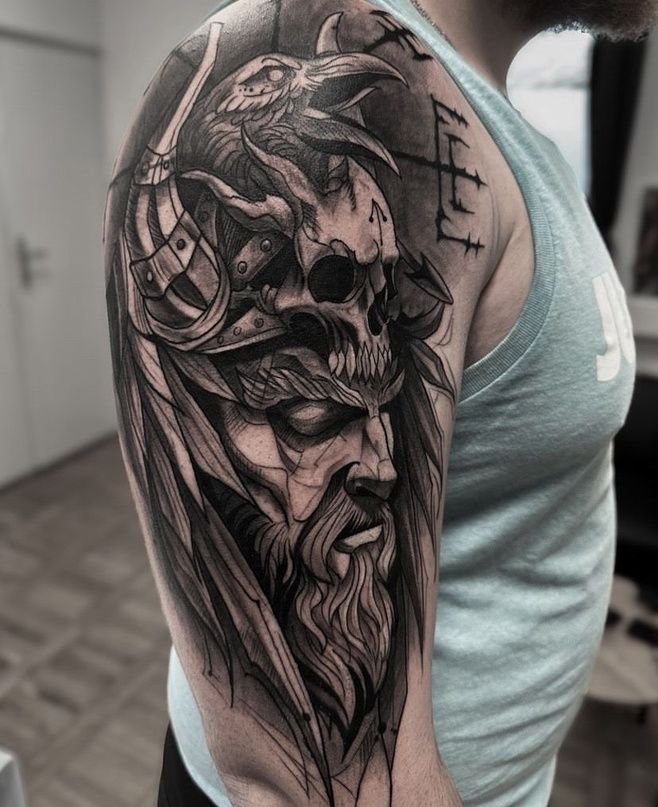
For a rugged, story-driven aesthetic, a Norse-inspired theme provides a dark, textured finish across the entire lower body. This style mixes bold ancient symbolism with atmospheric character portraits.
Design & Elements
Gods like Odin or Thor, legendary wolves like Fenrir, longships battling rough seas, and bindrunes form the core of Viking sleeves. Compass symbols like the Vegvísir fit flatly onto large muscle surfaces such as the outer thigh or side calf.
Flow & Placement
Braided knotwork patterns act as natural framing tools around the kneecap and Achilles tendon. The upper thigh holds the main mythological figures, while longships or ocean waves drape gracefully over the lower shin and ankle.
Shading & Maintenance
Heavy stippling, woodcut-style hatching, and weathered stone textures build the gritty atmosphere of Norse ink. Deep black contrast is key, ensuring small rune details remain legible even after years of skin healing.
4. Neo-Traditional Flora & Fauna
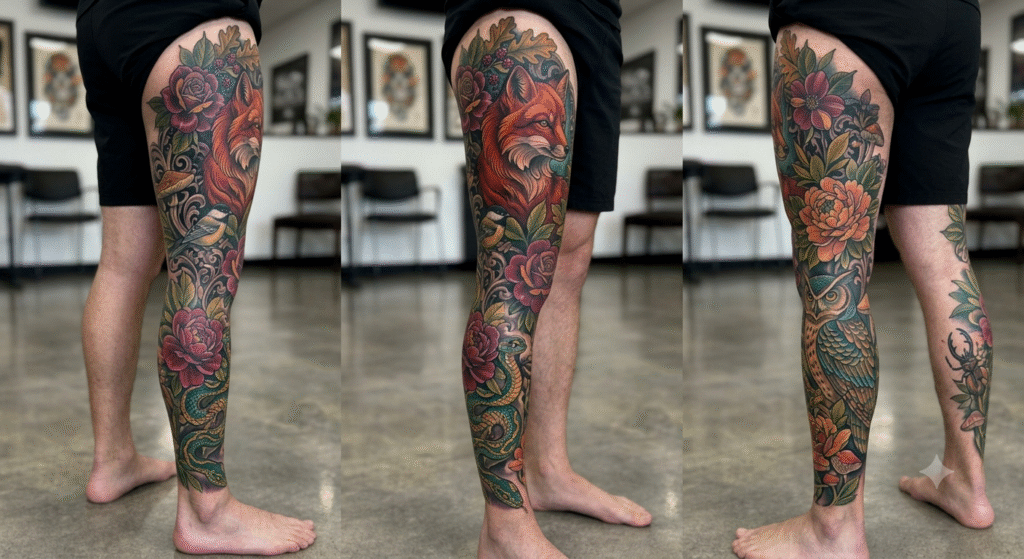
Neo-Traditional tattoos balance the structural durability of Old School tattooing with modern color palettes, illustrative line weights, and expressive illustrative depth.
Design & Elements
Snakes winding around blooming roses, owls perched on ornate daggers, and foxes surrounded by autumn foliage are classic Neo-Traditional setups. The bold outlines give the tattoo crisp visibility from a distance.
Flow & Placement
Elongated subjects—like a serpent or striking flora stems—work brilliantly on legs because they follow the vertical length of the fibula and tibia. Placing a large flower cluster right over the knee cap bridges upper and lower leg sections naturally.
Shading & Maintenance
This style utilizes rich color palettes featuring deep jewel tones, muted ochres, and sage greens alongside variable line weights. Line variation keeps the composition dynamic while maintaining structural longevity over time.
5. Biomechanical & 3D Bio-Organic

Source: Facebook
Biomechanical sleeve artwork transforms the leg into a fusion of synthetic mechanics and living anatomy, making it look as though internal machinery rests right beneath torn skin.
Design & Elements
Piston assemblies, hydraulic shocks, carbon fiber weave, and intricate gears make up the mechanical structure. Bio-organic variations incorporate alien textures, tendrils, and exo-skeletal plates instead of hard metal.
Flow & Placement
The mechanics must mirror actual biomechanics to look convincing. Springs placed near the calf muscle and joint hinges positioned near the knee joint give the optical illusion that the leg moves because of the tattooed machinery.
Shading & Maintenance
Hyper-realistic drop shadows, metallic chrome reflections, and deep black abysses behind open “skin rips” create the necessary 3D illusion. Masterful light placement prevents the complex mechanical detail from reading as visual clutter.
6. Chicano Style & Lettering
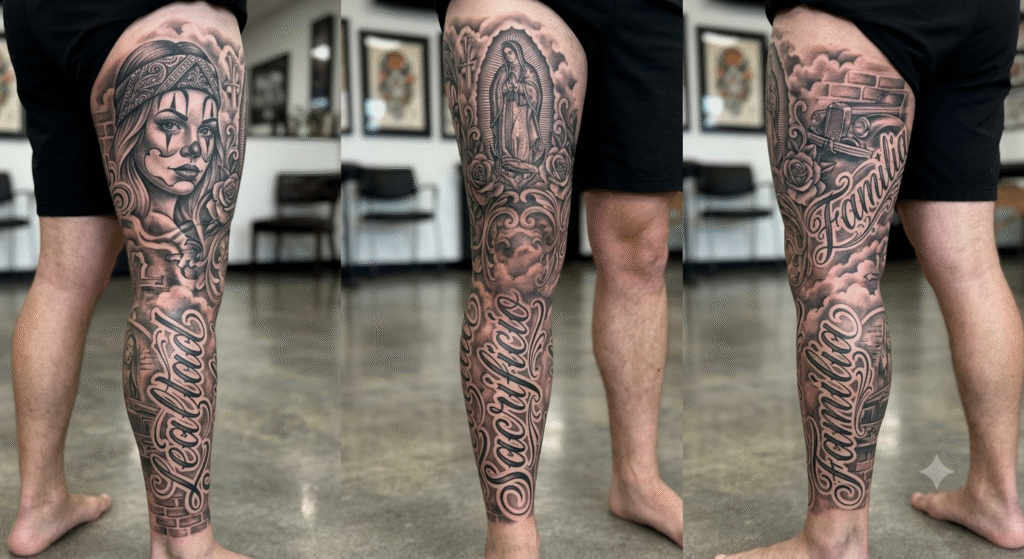
Rooted in West Coast tattoo culture, Chicano style combines fine-line black-and-grey shading with smooth gradients, dramatic script, and emotive storytelling.
Design & Elements
Payasa clown-girl portraits, classic lowrider cars, sacred heart motifs, and custom hand-drawn calligraphy are quintessential elements. Script lettering works seamlessly across the quad area or wrapped along the outer side of the calf.
Flow & Placement
Fine-line Chicano pieces require strategic balance so soft shading isn’t lost over large leg surfaces. Placing dramatic portrait faces on flat muscle real estate prevents facial distortion when flexing leg muscles.
Shading & Maintenance
Artists rely heavily on single-needle fine lines and delicate grey washes. Soft atmospheric clouds fill the negative space between scenes, binding distinct narrative panels into one cohesive full leg sleeve.
7. Dark Surrealism & Gothic Horror

Source: Facebook
For lovers of alternative art, dark surrealism delivers an eerie, thought-provoking aesthetic. This style mixes dreamlike logic with dark, gothic undertones for an unforgettable visual impact.
Design & Elements
Double-eyed portraiture, melting geometry, surreal skulls, and biomechanical nightmare imagery dominate this genre. The art leans into high drama, contrast, and psychological symbolism.
Flow & Placement
Because dark surrealism is abstract, compositions can wrap around awkwardly shaped areas like the back of the knee or ankle bone effortlessly. Swirling dark shadows merge separate elements smoothly across the leg’s entire length.
Shading & Maintenance
Saturated blacks combined with stark negative skin breaks create the unsettling atmosphere required for dark art. Keeping high-contrast white focal points sharp guarantees the surreal details stay readable.
Explore unique dark aesthetics further by reading about how to pull off a goth thigh tattoo for detailed gothic placement tips.
8. Botanical & Wildlife Rainforest

Source: Facebook
A botanical nature sleeve turns the entire lower limb into an immersive, living sanctuary filled with vibrant flora, dense foliage, and exotic wildlife.
Design & Elements
Jungle cats like leopards or jaguars, tropical toucans, blooming orchids, and sprawling palm fronds fill out the layout. The organic nature of plant leaves allows seamless coverage across complex joints.
Flow & Placement
A big cat head fits naturally on the upper thigh zone, while tropical vines, crawling insects, and tropical flowers cascade down the front of the shin and wrap around the calf muscle.
Shading & Maintenance
If executed in full color, rich greens, vibrant oranges, and vivid magentas create an eye-catching statement look. Black and grey botanical sleeves rely instead on realistic leaf vein textures and heavy contrast background fill.
9. Sacred Geometry & Mandala Dotwork
Source: Facebook
Sacred geometry uses mathematical patterns, dotwork (dot shading), and symmetrical mandalas to form complex architectural art across the body’s natural shape.
Design & Elements
Overlapping mandalas, Platonic solids, Metatron’s Cube, and repeating tessellations form the structural core. Dotwork gradients add soft depth to sharp, technical line art.
Flow & Placement
A large mandala centered directly over the kneecap serves as a stunning anchor point for geometric leg sleeves. Concentric pattern rings expand outward from the knee, extending up into the thigh and down toward the lower shin.
Shading & Maintenance
Crisp linework and precise dot density are crucial. Because geometric tattoos rely on exact symmetry, choosing an artist experienced in mapping patterns to curved body contours prevents lines from looking warped when standing.
10. Polynesian & Maori Blackwork Tribal

Source: Facebook
Traditional Polynesian, Samoan Tatau, and Maori Ta Moko represent some of the oldest full-body tattoo cultures in human history, offering powerful, solid black structural patterns.
Design & Elements
Spearheads, ocean waves, turtle shells (Honu), and tiki motifs are combined into intricate bands. Each symbol holds ancestral meanings of strength, protection, ocean navigation, and family lineage.
Flow & Placement
Tribal layouts follow the muscle anatomy directly, carving around the quadriceps, hamstring, calf, and ankle in distinct rhythmic bands that accentuate physical leg definition.
Shading & Maintenance
This style features expansive areas of solid black ink mixed with precise negative space lines. Solid blackwork requires meticulous needle saturation during application to ensure deep, even healing without patchy spots.
You can browse comprehensive style collections like 13 leg tattoo styles men are obsessing over to compare historical blackwork against modern interpretations.
tattoodreamstoday.com
11. Full Color Photorealism
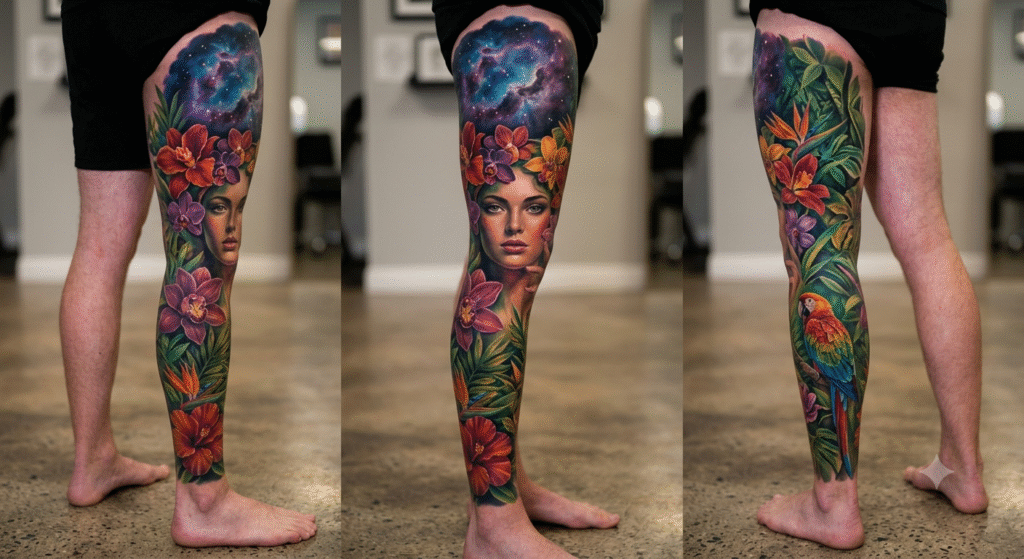
Full color photorealism converts the leg into a fine-art canvas, capturing painterly portraits, cinematic film scenes, or vibrant fantasy landscapes with incredible accuracy.
Design & Elements
Movie characters, space nebulae, mythological gods, or hyper-realistic ocean reefs benefit greatly from full-color saturation. The absence of heavy black outlines creates a true painting effect on skin.
Flow & Placement
Large-scale landscapes or high-detail portraits need smooth, flat surfaces. The outer thigh and the meaty portion of the calf provide ideal canvases for major color portraits, connected by atmospheric color blends.
Shading & Maintenance
Color realism demands expert knowledge of color theory, highlight layering, and skin tone undertones. Wearing high-SPF sunscreen is non-negotiable for color leg sleeves to protect delicate pigments from sun degradation.
To see how high-impact color work applies to other body areas, read about 13 epic bicep tattoos for men for additional color placement inspiration.
Key Factors When Planning a Leg Sleeve Tattoo
Designing a full leg sleeve requires careful preparation, financial budgeting, and physical endurance. Understanding what goes into completing a project of this scale guarantees a smoother tattoo experience.
Time Commitment & Session Scheduling
A complete leg sleeve typically takes anywhere from 25 to 50+ total studio hours, depending on detail level, style complexity, and color density. Most collectors break the project down into multiple day-sessions spaced 3 to 4 weeks apart to allow proper healing between passes.
Pain Scale & Sensitivity Zones
Pain varies significantly across different zones of the leg:
- Thigh (Outer & Front): Low to moderate pain; easiest area for long sessions.
- Calf (Back & Side): Moderate pain; manageable muscle cushion.
- Shin & Ankle: High sensitivity due to bone proximity.
- Kneecap & Back of Knee (Popliteal Fossa): Extremely intense sensitivity and heavy swelling zone.
Aftercare & Healing Dynamics
Because legs sustain heavy blood flow and daily physical movement, lower-body tattoos often swell significantly during the first 48–72 hours. Elevating the leg during rest, wearing loose-fitting clothing, avoiding tight socks, and maintaining a steady cleaning and moisturizing routine are essential for preserving crisp line quality and ink density.
Frequently Asked Questions
How long does a full leg sleeve tattoo take to complete?
Most leg sleeves require 4 to 8 full-day sessions, totaling 25 to 50+ hours of chair time. Detailed styles like color realism or biomechanical take longer than blackwork or illustrative layouts.
Which leg tattoo placement hurts the most?
The kneecap, the back of the knee, and the ankle area are universally considered the most painful spots due to thin skin, concentrated nerve endings, and proximity to bone.
How much does a complete leg sleeve tattoo cost?
Depending on the artist’s hourly rate and experience level, a full leg sleeve generally ranges between $3,000 and $8,000+. High-end realism specialists may charge more for custom multi-session projects.
Can I connect individual leg tattoos into a full sleeve later?
Yes. An experienced tattoo artist can design filler background elements—such as clouds, geometric patterns, smoke, or organic foliage—to tie existing calf or thigh tattoos into one cohesive sleeve layout.
Conclusion
Investing in a full leg sleeve tattoo is a transformative journey that blends personal storytelling with bold artistic expression. From the intricate detail of hyper-realism and geometric patterns to the striking impact of traditional Japanese or tribal blackwork, each style offers a unique way to turn your lower body into a cohesive masterpiece. Taking the time to select a distinct concept, plan around your body’s natural contours, and collaborate closely with an experienced artist will ensure your leg sleeve looks stunning from every angle for years to come.