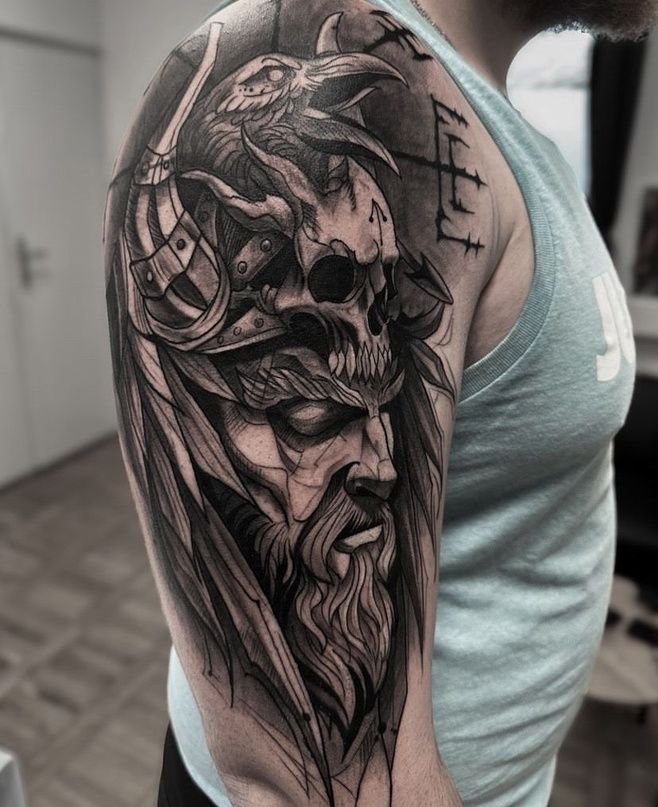
Medusa has become one of the most requested tattoo subjects of the past decade, and it’s easy to see why. The mythological Gorgon carries layers of meaning — transformation, feminine power, protection, and defiance — all wrapped up in a visually dramatic image that translates beautifully onto skin.
Her story has also been reinterpreted through a modern lens. Where ancient myth cast her as a monster, contemporary culture increasingly reads Medusa as a figure of survival and reclaimed power — a woman wronged by gods who turned her pain into armor. That duality between monster and martyr is part of what makes her such a compelling tattoo subject.
The thigh is an especially popular canvas for Medusa tattoos. It offers generous surface area for detail, allows for easy concealment, and provides a naturally curved shape that works well with flowing hair, serpents, and ornamental framing. Whether you want a soft, ethereal portrait or a bold, graphic statement piece, the thigh can accommodate almost any creative vision.
Below you’ll find 13 distinct Medusa thigh tattoo ideas, each with style notes, symbolism, and placement advice to help you walk into your next tattoo appointment with a clear creative direction.
1. Classic Black and Gray Medusa Portrait
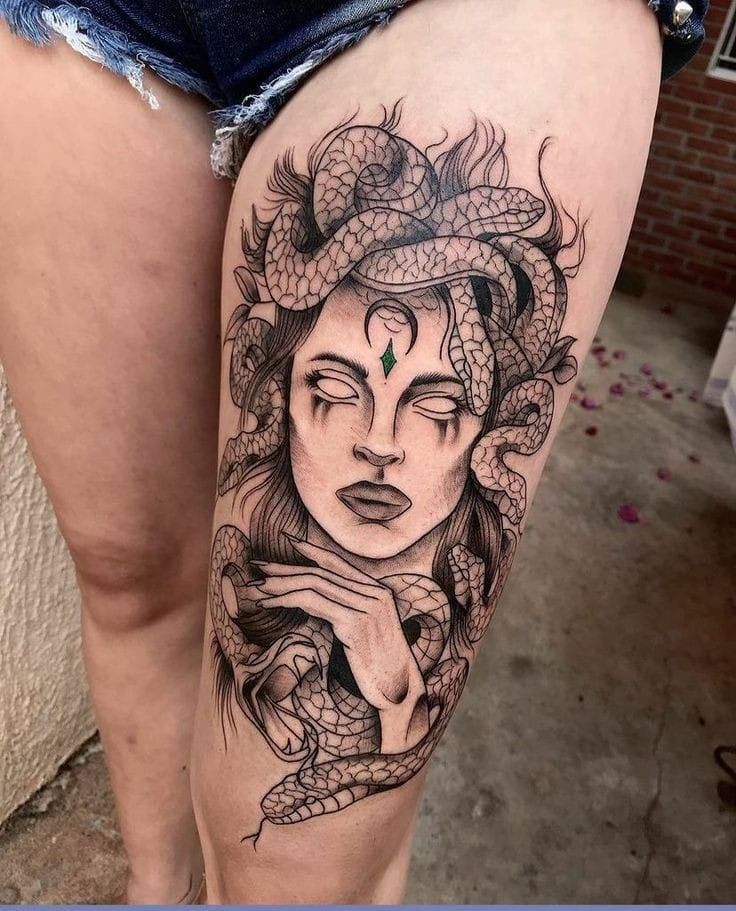
A black and gray realism portrait is the most timeless interpretation of a Medusa thigh tattoo. Skilled artists render every coiled serpent, every shadow under the cheekbones, and every strand of hair with photographic depth using only black ink and precise shading technique.
This style rewards patience — a well-executed portrait takes multiple sessions and requires an artist who specializes in realism. The payoff is a piece that looks almost sculptural on the thigh, catching the light in a way that flat linework simply cannot match. Details like the subtle scales on each serpent, the texture of Medusa’s skin, and the depth of her gaze all come alive through layered gray washes and careful highlight placement.
For placement, center the portrait on the outer thigh. This gives the composition room to breathe and keeps the focal point — Medusa’s face — at the widest, flattest part of the thigh for maximum visual impact. Many artists extend the serpentine hair upward toward the hip to create natural vertical flow without needing to add decorative filler.
2. Fine Line Medusa Thigh Tattoo
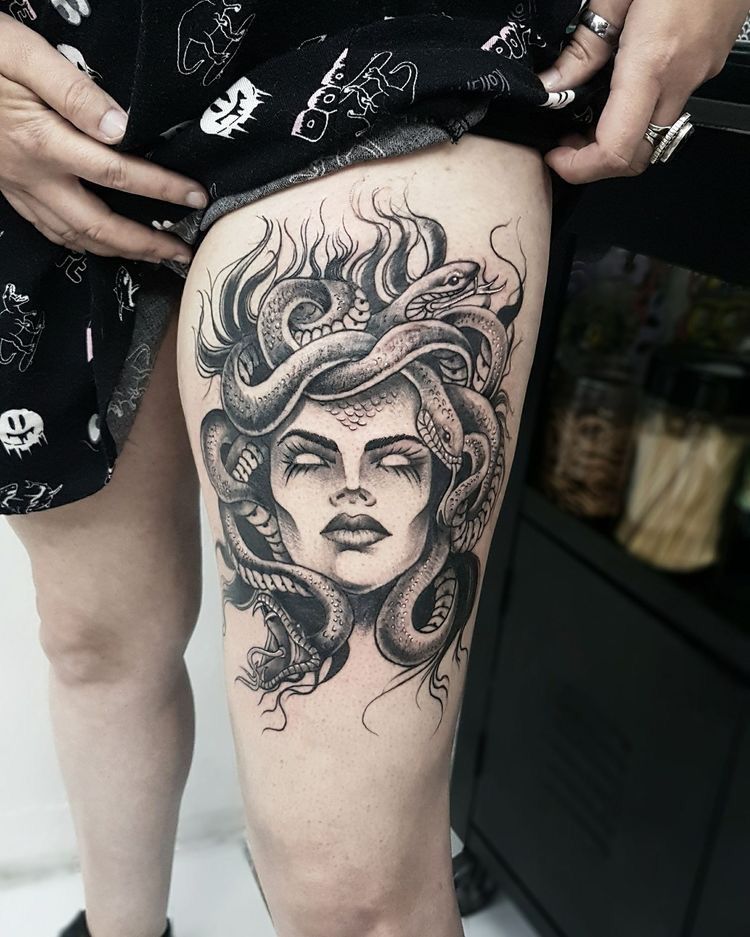
Fine line work has completely transformed how delicate tattoos look on the body. A fine line Medusa thigh tattoo trades dramatic shading for precise, hair-thin linework that creates an almost engraved illustration quality — elegant, refined, and surprisingly detailed.
Snakes are rendered as intricate, overlapping coils with texture suggested through micro-hatching rather than solid fills. Medusa’s expression tends to be softer in fine line pieces, often carrying a melancholic or contemplative quality rather than the stone-cold gaze of more traditional depictions. The overall effect is closer to an antique copperplate etching than a conventional tattoo, which appeals strongly to people who love understated, art-forward body art.
Keep in mind that fine line tattoos require excellent aftercare and may need touch-ups over time, as very thin lines can soften slightly with aging skin. An experienced fine line artist will factor longevity into the design from the start — building in slightly thicker anchor lines that preserve the composition’s structure even as the finer details evolve.
3. Neo-Traditional Medusa with Bold Color
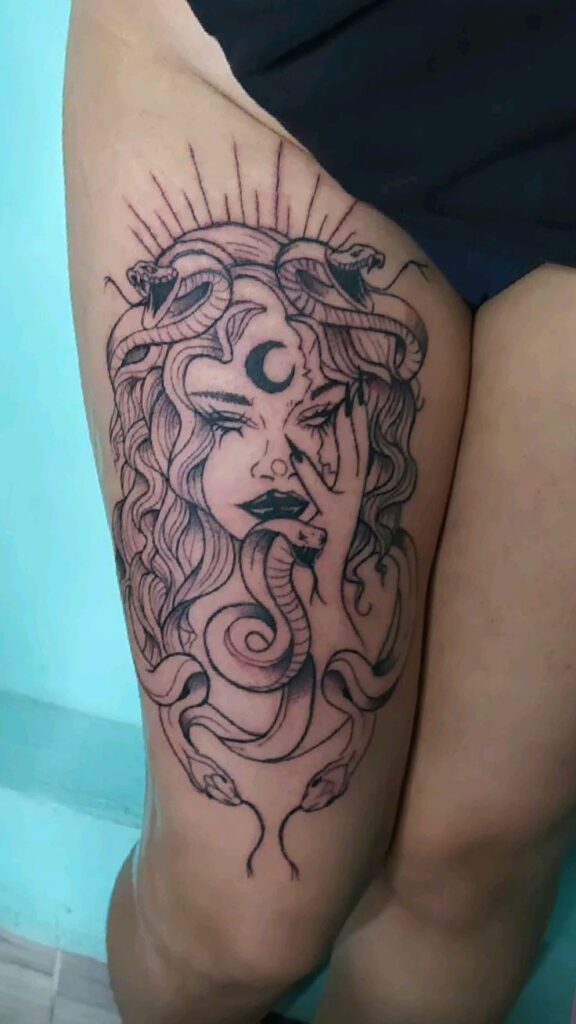
Neo-traditional style takes the bold outlines and graphic clarity of traditional tattooing and injects it with modern color palettes, layered shading, and more complex compositions. A neo-traditional Medusa thigh tattoo is vibrant, stylized, and immediately eye-catching.
Deep jewel tones work especially well — forest green for the snakes, burgundy for lips, gold for ornamental framing, and violet shadows across the face. The result feels both vintage and fresh at the same time, like a mythological illustration pulled from an art nouveau manuscript. Artists often add flourishes like decorative borders, scrollwork, or small secondary elements such as daggers or hourglasses to fill the thigh without overcrowding the central portrait.
This style works beautifully when combined with floral framing. Peonies, roses, or chrysanthemums surrounding Medusa’s head add softness to the composition and extend the tattoo’s visual footprint naturally down the thigh. If you love florals, it’s worth exploring how a rose thigh tattoo concept could be worked into the decorative frame around a neo-traditional Medusa portrait, creating a cohesive piece where the floral and mythological elements feel inseparable.
4. Medusa with Snake Hair in Illustrative Style
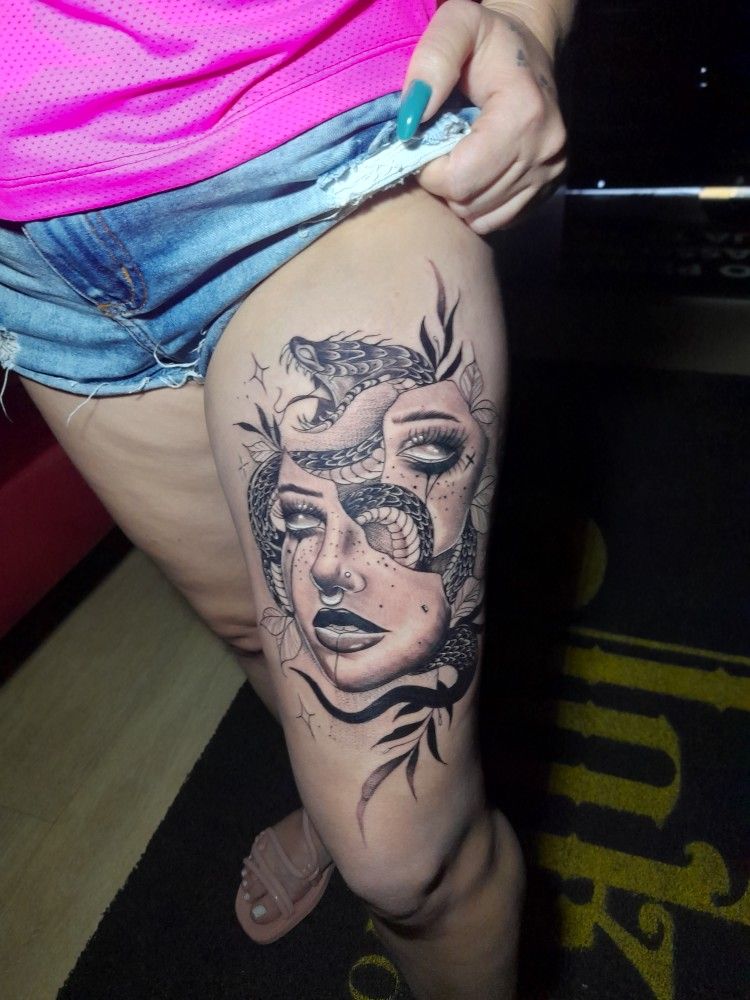
Illustrative tattooing sits somewhere between realism and graphic art — it prioritizes visual storytelling, stylized line work, and creative composition over strict photorealism. An illustrative Medusa thigh tattoo gives artists the freedom to exaggerate Medusa’s serpentine hair in dramatic, flowing ways that feel more artistic than anatomical.
Artists often render each snake with its own personality — some baring fangs, others curling away lazily, a few coiling upward as if alive. The result is a Medusa that feels dynamic and almost animated, as though the snakes might shift if you look away. Crosshatching, stippling, and loose ink wash effects are all common in this style, giving each artist space to bring a distinct visual voice to the piece.
For a cohesive thigh piece, ask your artist to let the snake tails trail naturally down the thigh, creating a vertical composition that follows the leg’s natural line. This makes the tattoo feel integrated with the body rather than simply placed on top of it — a distinction that separates great thigh tattoos from average ones.
5. Medusa and Koi Fish Combination Tattoo
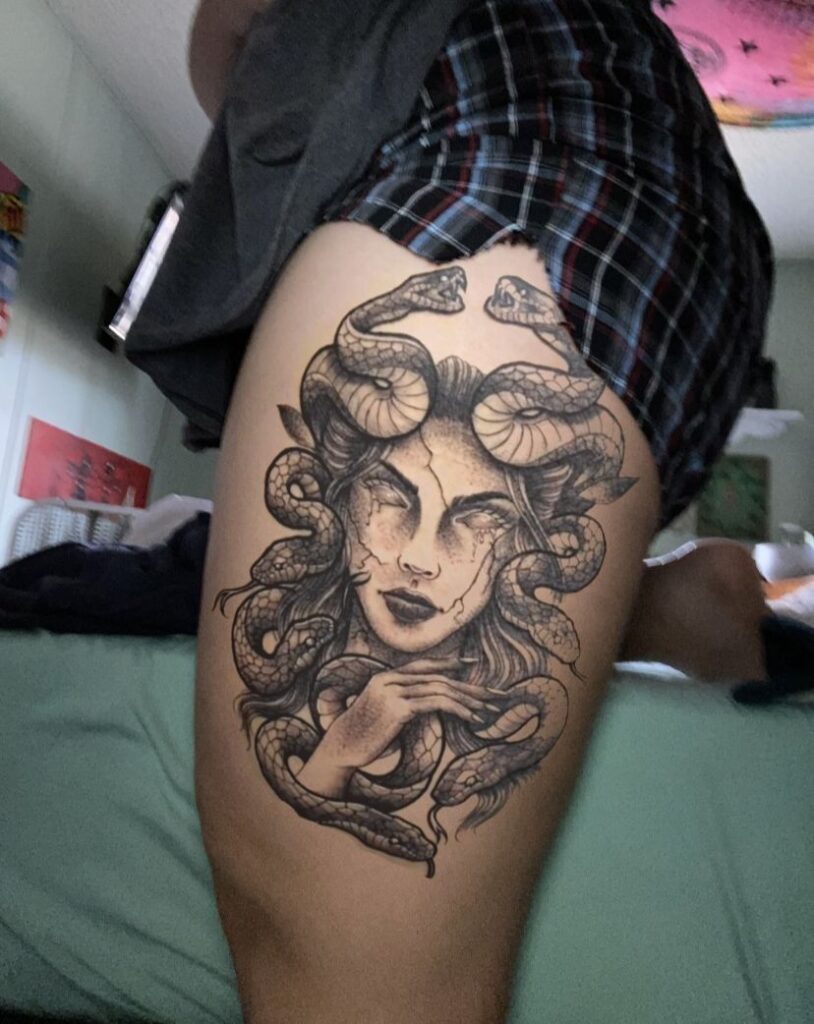
Combining Medusa with koi fish creates a thigh tattoo that merges two of mythology’s most symbol-rich subjects. Koi represent perseverance, transformation, and the courage to swim against the current — themes that echo Medusa’s own story of endurance and reinvention.
Compositionally, this pairing works beautifully on the thigh. Medusa’s face anchors the upper portion while koi fish flow downward, their bodies curved to follow the thigh’s natural contour. Water, waves, and lotus flowers can fill negative space to create a fully realized mythological scene. In Japanese-influenced interpretations, the koi might swim through clouds or cascading waterfalls, giving the piece a distinctly east-meets-west quality that feels genuinely original.
If you’re drawn to aquatic imagery on the thigh, browsing koi fish thigh tattoo designs can help you understand how fish-shaped compositions work with the thigh’s anatomy before committing to a combined piece. Getting the scale relationship between Medusa’s portrait and the koi right is key to a balanced final result.
6. Watercolor Medusa Thigh Tattoo
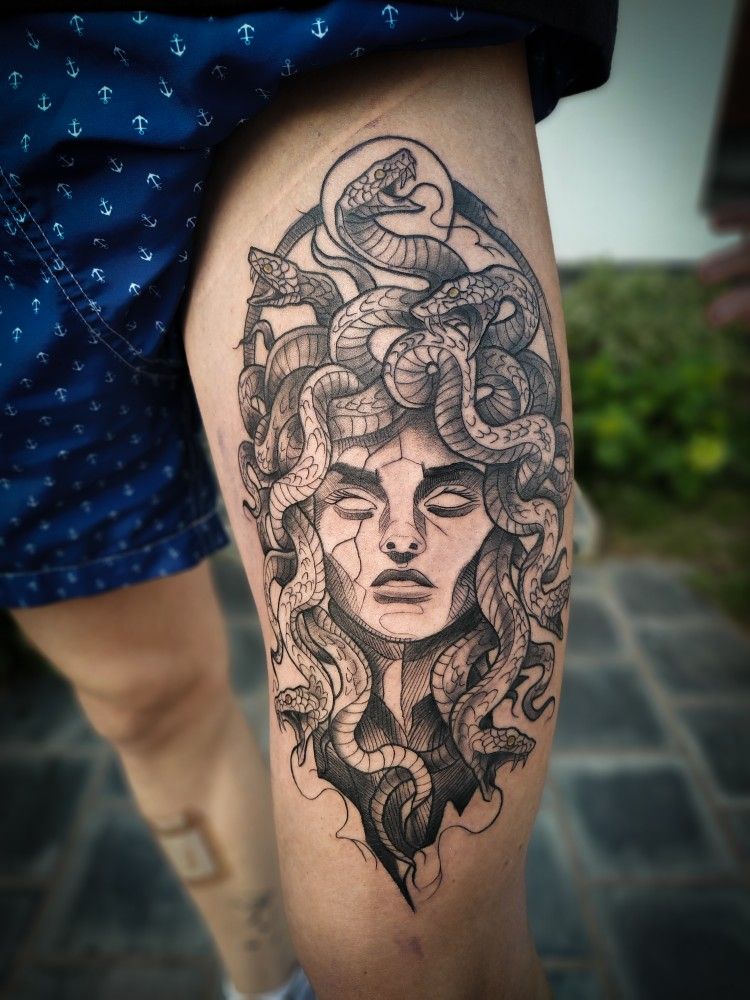
Watercolor tattoos use soft washes of pigment, diffused edges, and ink splashes to mimic the unpredictable quality of watercolor paint. Applied to a Medusa portrait, this technique creates a dreamy, almost mythological atmosphere where the figure seems to emerge from color rather than shadow.
Warm sunset tones — coral, amber, and gold — contrast beautifully against the cold green of serpents and give the piece an otherworldly glow. Some artists layer a faint black ink sketch beneath the color wash to preserve structural clarity while still achieving that painterly aesthetic. The contrast between crisp linework and bleeding color creates the visual tension that makes watercolor tattoos so compelling.
Watercolor tattoos fade faster than traditional ink work and benefit from UV protection during healing and sun exposure. Choosing an artist experienced in color saturation will help the vibrancy last significantly longer. Scheduling a color refresh two to three years after the original sitting is common with this style and keeps the piece looking vibrant rather than washed out.
7. Minimal Medusa Outline Tattoo
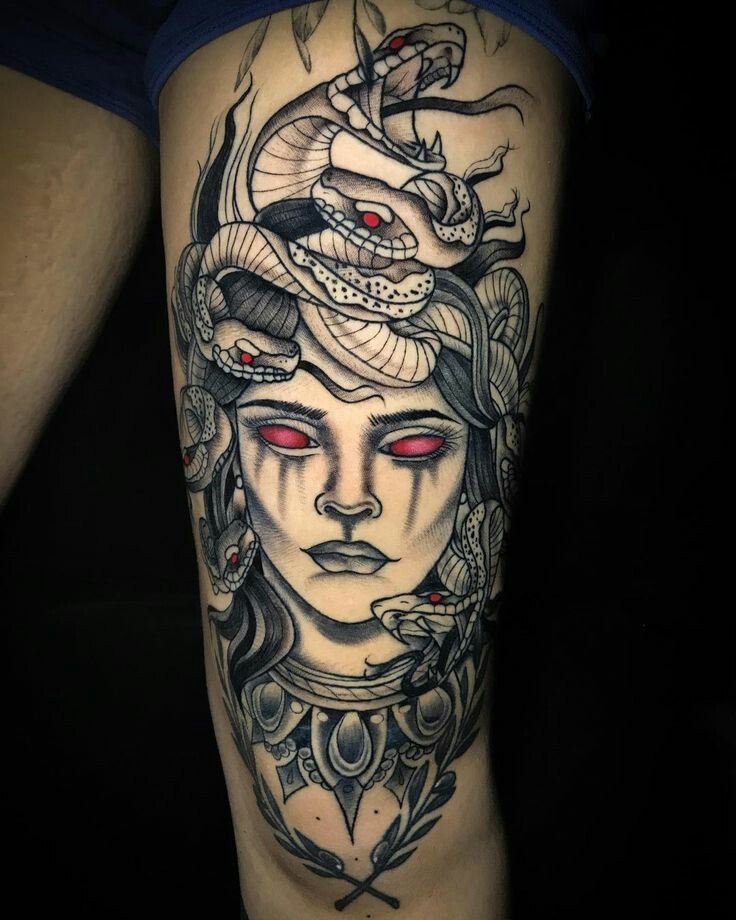
Not every Medusa tattoo needs to command the entire thigh. A minimal outline version — just the profile of the face, a suggestion of serpentine hair, and perhaps one bold eye — can be just as striking in its restraint. Minimal tattoos make a quiet statement that rewards a second look.
Single-needle outlines give this style its characteristic delicacy. Some artists add only a tiny detail — a single scaled snake, an open eye, or a geometric border — to give the outline depth without adding visual noise. Others take a sketch-like approach, incorporating visible pen-stroke lines that make the tattoo look like a spontaneous drawing transferred permanently to skin.
This style suits people who prefer understated body art or who are planning a thigh piece as part of a larger leg composition and want Medusa to read as one element among many rather than the sole centerpiece. It also works well for first-time tattoo collectors who want to test a placement and style before committing to larger work.
8. Baroque-Framed Medusa Medallion
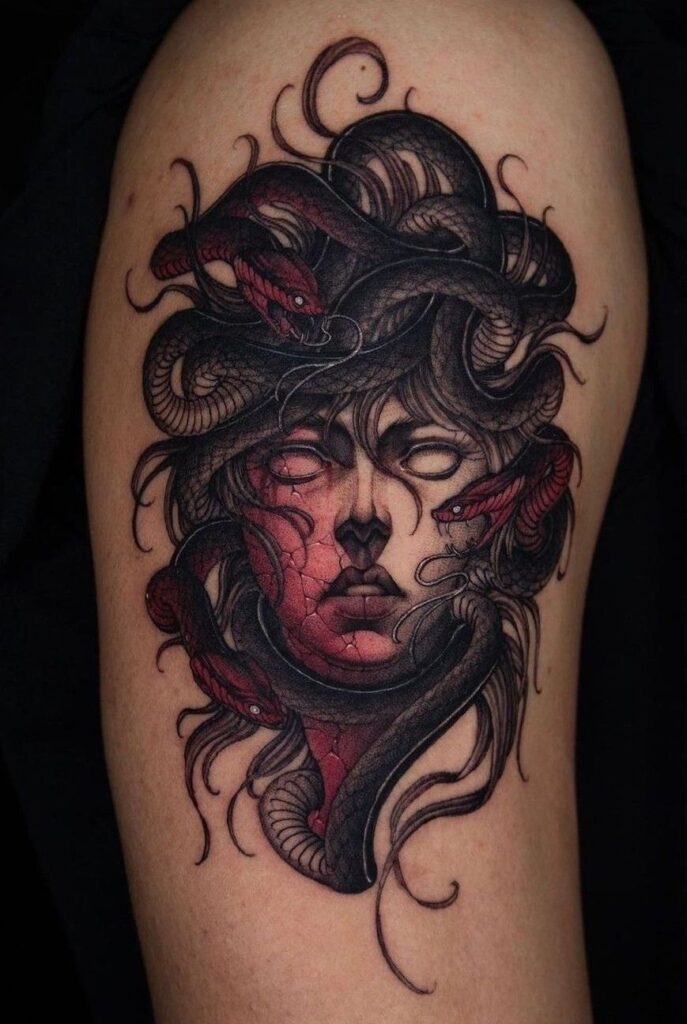
A medallion-style Medusa tattoo frames the portrait within an ornate baroque or rococo-inspired border — scrollwork, laurel leaves, banners, pearls, and filigree all arranged around the central figure like a carved cameo or antique locket.
This approach gives the tattoo a finished, self-contained quality. The border functions as a visual container that tells the viewer exactly where the piece begins and ends, making it feel intentional and museum-quality rather than open-ended. The baroque aesthetic also adds an air of classical authority to Medusa’s portrait — she becomes not just a mythological figure but an icon, immortalized in ink as though carved in marble or hammered into gold.
Black and gray ink is the most common choice for medallion tattoos because it emphasizes texture and relief, but warm sepia tones can push the aesthetic toward an antique coin or Roman seal, which suits the mythological subject matter perfectly. Some artists incorporate actual Latin inscriptions or Greek phrases into the banner elements for additional historical authenticity.
9. Dark Goddess Medusa with Moon Motifs
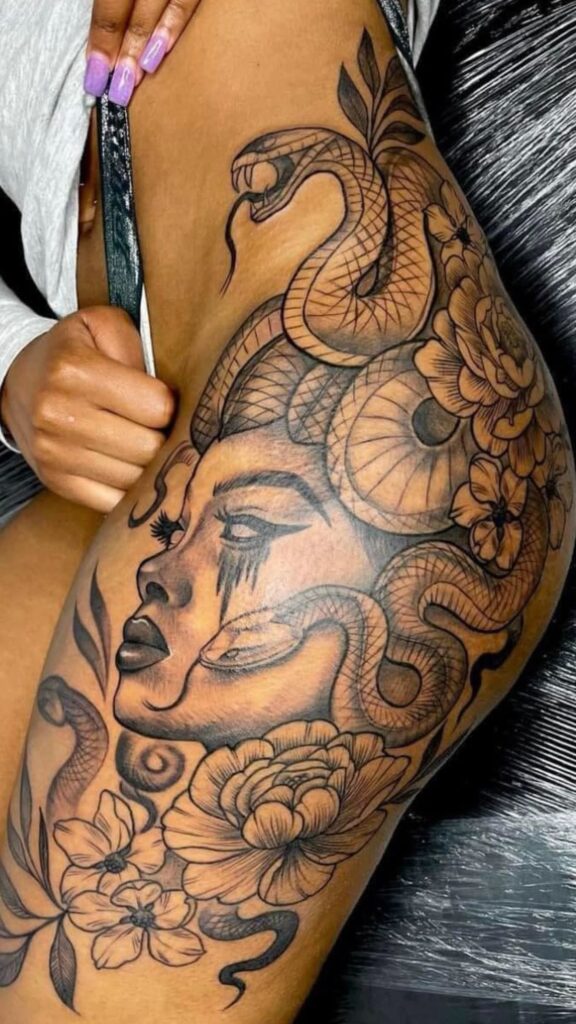
Medusa is frequently reclaimed in contemporary tattoo culture as a symbol of feminine power and dark goddess energy. Pairing her portrait with crescent moons, stars, celestial halos, or lunar phases amplifies that spiritual resonance and creates a tattoo steeped in sacred feminine symbolism.
A crescent moon behind Medusa’s head reads like a crown. A full moon as a backdrop turns the composition into something almost ritualistic. Phases of the moon arranged in an arc above or below the portrait connect Medusa to cycles of transformation — death, rebirth, and the eternal turning of nature. Stars scattered through the composition reinforce that sense of cosmic scale, making the tattoo feel less like body art and more like a devotional image.
This concept pairs especially well with black work or dark neo-traditional styles that aren’t afraid of deep shadows and high contrast. The result is dramatic, intentional, and rich with layered meaning — a tattoo that speaks clearly both as visual art and as personal statement.
10. Medusa Surrounded by Butterflies
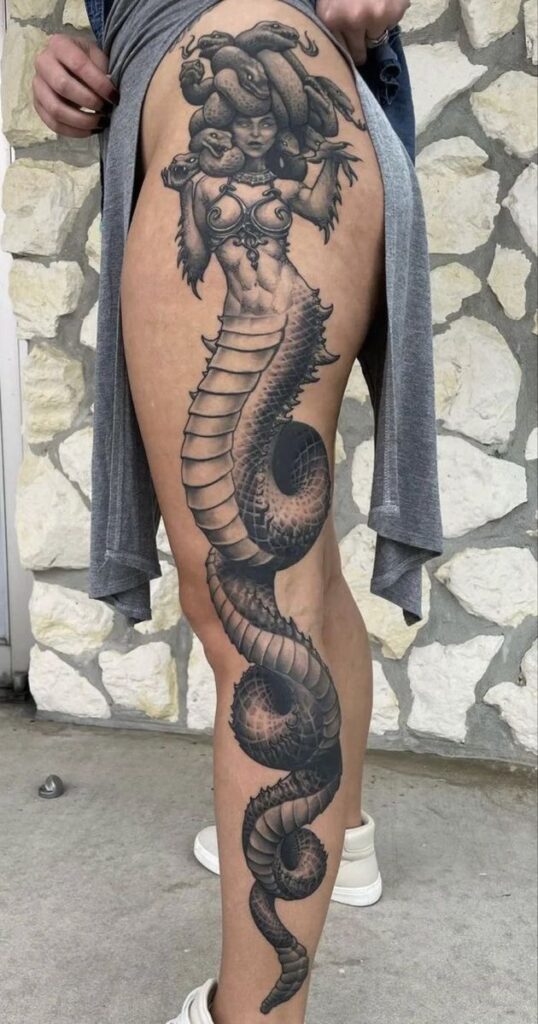
Butterflies soften the inherently powerful and sometimes intimidating subject of Medusa. Placing delicate winged creatures around her face or tangled in her serpentine hair creates a visual tension between danger and fragility — a tension that many people find deeply meaningful and personally resonant.
Butterflies carry their own weight in tattoo symbolism: transformation, freedom, impermanence, and rebirth. Combined with Medusa’s themes of metamorphosis and reclaimed power, the two images create a layered narrative about surviving change and emerging stronger. In some compositions, the butterflies appear to fly out of Medusa’s hair as though the serpents have transformed and taken flight — a visual metaphor that adds yet another layer of meaning to the piece.
Understanding how butterflies work compositionally on the thigh is useful before committing to a combined design. Exploring butterfly tattoo thigh ideas can give you a sense of scale, placement, and how butterfly wings interact with the thigh’s curved surface when paired with a larger central subject like a portrait.
11. Traditional Greek Mythology Style
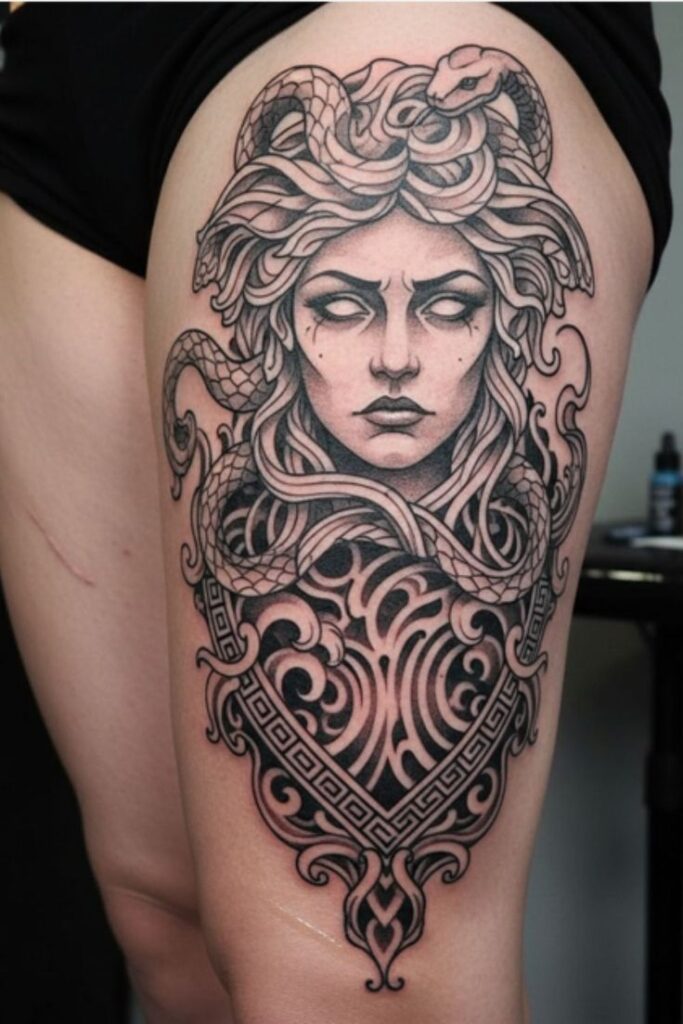
Greek myth depicted in the style of ancient pottery, mosaic, or red-figure vase painting is having a serious resurgence in tattoo art. A Medusa rendered in this aesthetic uses flat, graphic shapes, bold outlines, and the terracotta-and-black color palette of ancient ceramics to create something that feels like wearable archaeology.
This style suits people who love the intellectual dimension of mythology — the tattoo isn’t just aesthetically striking, it’s also a direct reference to how Greeks actually imagined and depicted the Gorgon thousands of years ago. Perseus holding Medusa’s severed head, or Athena wearing the Aegis adorned with the Gorgoneion, are classic narrative scenes that work well in this flat, antiquity-inspired approach. The style also lends itself to frieze-style horizontal compositions that wrap around the upper thigh for a toga-like visual effect.
The thigh is an ideal placement for this aesthetic because the relatively flat, wide surface works better for these graphic, non-dimensional designs. The bold outlines and simple fills also hold up beautifully over time without the fading risks associated with complex shading or watercolor techniques.
12. Medusa as a Protective Talisman
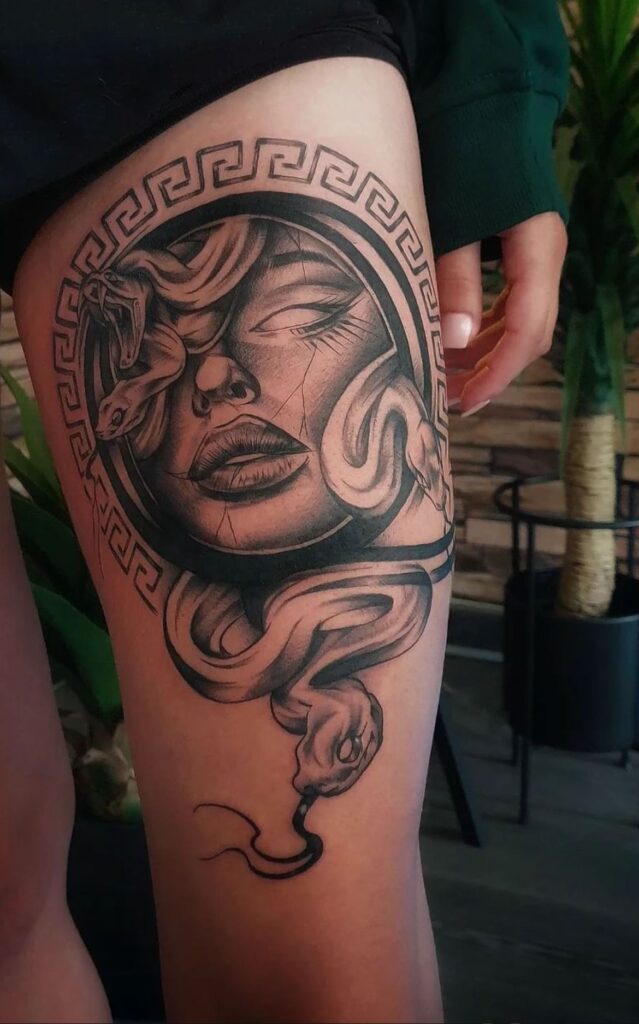
In ancient Greece and Rome, the image of Medusa — known as the Gorgoneion — was used as an apotropaic symbol: a ward against evil. Shields, temples, buildings, jewelry, and coins all bore her likeness as protection for the wearer or inhabitant. Reclaiming this historical function in a modern tattoo is both intellectually grounded and deeply personal.
A protective talisman Medusa tattoo often emphasizes the gaze — large, open eyes that seem to stare outward from the thigh with unwavering intensity. Some artists surround the face with protective symbols from various traditions: the evil eye, hamsa hand, runic inscriptions, or geometric shields that reinforce the apotropaic intent. The result is a tattoo that functions almost like a spell — visible armor that communicates strength and warns against harm.
This concept resonates strongly with people who have overcome trauma, abuse, or a period of intense vulnerability. The tattoo becomes a statement of self-protection and hard-won resilience, rooted in thousands of years of symbolic history that gives the personal meaning a universal weight.
13. Geometric and Dotwork Medusa

Geometric and dotwork tattooing brings mathematical precision to organic subjects. A dotwork Medusa uses thousands of tiny ink dots, varying in density, to create shading and depth without a single solid line — the result is almost pointillist, with a rich textural quality at close range and clean graphic clarity from a distance.
Combining geometric shapes with Medusa’s portrait — mandala halos, sacred geometry, triangular framing, or hexagonal grids — adds an almost alchemical quality to the design. The contrast between the organic curves of a human face and the rigid precision of mathematical geometry creates immediate visual interest. Some artists use geometric shapes to fragment the portrait deliberately, breaking Medusa’s face into tessellated planes like a shattered mirror — a powerful metaphor for transformation and broken identity.
This style ages gracefully because dot clusters hold definition better than fine hairlines, and because the geometric elements give the composition clear structure that remains legible even as the skin changes over decades. It’s also a versatile choice for people who want a tattoo that bridges ornamental and figurative art without committing entirely to either category.
Tips for Getting a Medusa Thigh Tattoo
Choose the Right Artist
Medusa tattoos are technically demanding regardless of the style you choose. Portrait realism artists excel at black and gray work; illustrative tattooers handle flowing serpent compositions and expressive faces; neo-traditional artists manage complex color blending and ornamental framing. Research portfolios carefully and look specifically for mythology or portrait work — not just general thigh tattoos. An artist who can draw faces well is non-negotiable for a piece centered on a human portrait.
Consider Scale and Coverage
The outer thigh can accommodate a piece roughly the size of your palm up to a full thigh sleeve depending on your vision. Decide early whether you want a focused portrait or an immersive scene, as this affects session count, budget, and aftercare complexity. A large thigh piece spanning the hip to the knee will typically require two to four sessions for full completion, while a smaller medallion-style portrait may be achievable in a single sitting.
Think About Composition Flow
Great thigh tattoos follow the body’s natural lines rather than fighting against them. Ask your artist to design the piece so that it flows with the thigh’s contour. Serpents that coil around the thigh or compositional elements that trail toward the hip or knee read as far more organic and intentional than a portrait that simply sits flat on the surface like a sticker. A good consultation will include discussion of how the design moves when you walk or sit.
Plan for Touch-Ups
Thighs experience daily friction from clothing and are prone to moderate fading, particularly in the inner thigh area. Budget for a touch-up session approximately one year after the initial piece and protect the tattoo from prolonged sun exposure to maintain line integrity and color saturation. Applying a high-SPF sunscreen once the tattoo is fully healed is one of the single most effective things you can do to preserve its quality long-term.
Final Thoughts
Medusa is one of those rare tattoo subjects that carries equal weight as myth, symbol, and pure visual spectacle. The range of styles available — from stark minimalism to baroque maximalism, from ancient Greek pottery to modern watercolor — means there is a Medusa thigh tattoo for virtually every aesthetic preference and personal narrative.
What makes a Medusa tattoo truly memorable is the combination of a clear creative vision and an artist who has the technical skill to bring it to life. Take your time with research, collect reference images from multiple sources, and go into your consultation knowing exactly what you want the tattoo to say about you. A great tattoo artist will take that foundation and elevate it in ways you haven’t even imagined yet.
Whether you choose a quiet fine line portrait or a dramatic full-color composition surrounded by serpents, moons, and flowers, Medusa on your thigh will never go unnoticed — and that’s precisely the point.